

Key Takeaways (TL;DR)
If you are a founder or revenue leader without the time to read the full breakdown, here is what you need to know:
The Core Problem: Most American go-to-market firms were built for the era of static lists and broad campaigns. B2B SaaS companies in 2026 need their sales pipeline tied to actual buying signals, not impressions or content volume.
The Market Shift: Go-to-market agencies in the United States have split into two camps: firms experimenting with high-volume, controversial outbound mechanics, and firms building durable, owned revenue infrastructure that compounds over time.
Top Pick: The GTM Engineering Company earns the top spot among the best GTM agencies in the US for its engineering-first approach to building automated, owned systems, particularly well suited to VC-backed startups that need results without headcount bloat.
What's Changed: A growing number of US B2B GTM agencies now operate as solo-founder or small-team shops, built around deep Clay expertise rather than large account teams, which has reshaped what buyers should expect from a typical engagement.
What to Look For: Prioritize a partner who builds systems you own at the end of the engagement, rather than a vendor running a black-box campaign that disappears the moment the retainer ends.
Top GTM Agencies in the US at a Glance
Agency | Type | Best For | Key Differentiator |
1. The GTM Engineering Company | GTM Engineering & RevOps | Seed to Series B SaaS | Owned systems, transparent pricing, weekly execution |
2. The Deal Lab | Experimental Outbound & Messaging | Startups needing rapid message testing | Scientific, high-velocity experimentation framework |
3. Frontal | AI-Native Revenue Systems | B2B companies at $3M+ ARR | Build-then-handoff model across outbound, ads, content |
4. Growth Alliance | Embedded Revenue Engineering | $5M to $100M ARR B2B companies | Senior operators embedded for fixed 90-day sprints |
5. OneGTM | Solo-Founder GTM Advisory | Early and growth-stage technical teams | Direct access to a single Clay-certified operator |
6. Infinite Skills | Clay-Powered Lead Generation | Small B2B teams needing qualified leads | Signal-based prospect delivery without a strategy layer |
What Is a GTM Agency?
A go-to-market agency is a partner that helps companies take a product to market and turn it into repeatable revenue.
In practice, the scope varies considerably across American go-to-market firms. Some focus purely on outbound experimentation and messaging. Others build the full operational backbone, including CRM architecture, enrichment infrastructure, and signal-based automation that runs without constant human input.
For B2B SaaS companies specifically, a strong GTM agency typically covers some mix of ICP definition, messaging validation, tech stack implementation, and pipeline generation.
The best ones do not stop at a strategy deck, but instead build the system alongside the client's own team – while staying accountable for whether that system actually produces a recurring pipeline.
How the US GTM Agency Market Has Changed in 2025-2026?
Back in 2023-24, hiring a GTM agency in the US typically involved outsourcing a handful of outbound campaigns to a team that simply ran sequences through your existing tools.
That model still exists, but it no longer represents where the most interesting work in the category is happening.
With the introduction of AI-powered tools and stricter email protocols in effect over the past few years – the market has changed considerably.
Here’s how:
1. AI has become the operating layer, not a feature
The strongest go-to-market agencies in the United States are no longer treating AI as a way to personalize email copy faster. They are building enrichment pipelines that keep CRM records current automatically, scoring systems that update from live intent data, and outbound sequences that trigger without anyone manually pulling a list.
AI sits underneath the system now, rather than being bolted onto it.
2. Solo operators are competing with full-service shops
One of the more notable shifts among top GTM agencies in the USA is the rise of single-founder or small-team operators who have built deep, certified expertise in a narrow toolset, most often Clay.
These operators compete directly against larger agencies by offering founder-level attention and technical depth, even though their delivery capacity is smaller by design.
3. Experimentation has become its own discipline
A subset of American go-to-market firms has built an entire methodology around testing and validating messaging before committing a meaningful budget to scaling it.
Rather than assuming a positioning angle will work and spending months proving otherwise, these firms run structured experiments to find message-market fit first, then scale only what already shows traction.
4. Ownership remains the dividing line
As in the broader RevOps category, the clearest signal of quality among US B2B GTM agencies is whether the client owns the system at the end of the engagement.
Firms that build inside a vendor-controlled environment and walk away with the keys when the retainer ends are becoming less competitive against firms that document everything and hand over full operational control.
The Best GTM Agencies in the US: Top 6 Services Compared
1. The GTM Engineering Company

Best For: Seed to Series B startups needing scalable pipeline infrastructure without the overhead of an in-house RevOps hire.
Overview
The GTM Engineering Company takes the top position on this list of the best GTM agencies in the US because it addresses the specific pressure early-stage founders actually face: the need to build fast and build correctly at the same time.
Where most American go-to-market firms offer advisory work or run campaigns on a client's behalf, The GTM Engineering Company builds. They operate not as consultants who hand over a slide deck, but as fractional architects who install a working revenue engine inside the client's own stack.
The firm was founded by Jorge Macías, a Y Combinator S18 alumnus who has built GTM systems and achieved measurable pipeline results for over 100 companies.
That operational background shows up in how engagements are structured: weekly working sessions inside the client's own CRM, with every workflow documented with a Loom walkthrough and a written SOP.
The company is known for its clear commitment to helping the client fully own the system, even when the engagement ends.
Core Services
Evergreen Enrichment Infrastructure: a continuously updated enrichment layer in Clay that keeps every CRM record current across firmographic, technographic, and intent data, covering accounts, contacts, and leads
Signal-Based Outbound: sequences triggered by real events such as traffic growth, new hires, funding rounds, or product usage spikes, rather than static list pulls
AI Scoring Architecture: ICP fit combined with live intent signals, pushed into the CRM and used to route and prioritize rep activity automatically
Full CRM Build and Cleanup: HubSpot and Salesforce architecture covering contact-to-account linkage, lifecycle logic, deduplication, and attribution
Inbound Intelligence: pre-meeting briefs auto-generated for every booked call, delivered to reps in Slack the morning of the conversation
Pros
Fast time to value, with systems shipping in weeks rather than quarters
Builds inside the client's own stack, not a vendor-managed environment
Every deliverable includes a Loom walkthrough and a written SOP
Transparent pricing starting at $4,000 a month with no hidden retainer structures
Cons
Engagement model requires some client availability for weekly sessions
May be more than needed for companies with a single, narrow workflow problem
Why It Stands Out
The GTM Engineering Company is the only firm in this category that combines fractional GTM engineering, transparent tiered pricing, and full system ownership, with weekly hands-on sessions and comprehensive documentation baked into every engagement.
Clients are not buying a black box.
They are building infrastructure they can operate and extend independently long after the engagement ends, which is exactly the standard the rest of this list is measured against.
2. The Deal Lab
Best For: Startups that need to validate messaging and book meetings quickly before committing budget to a larger GTM scale-up.
Overview
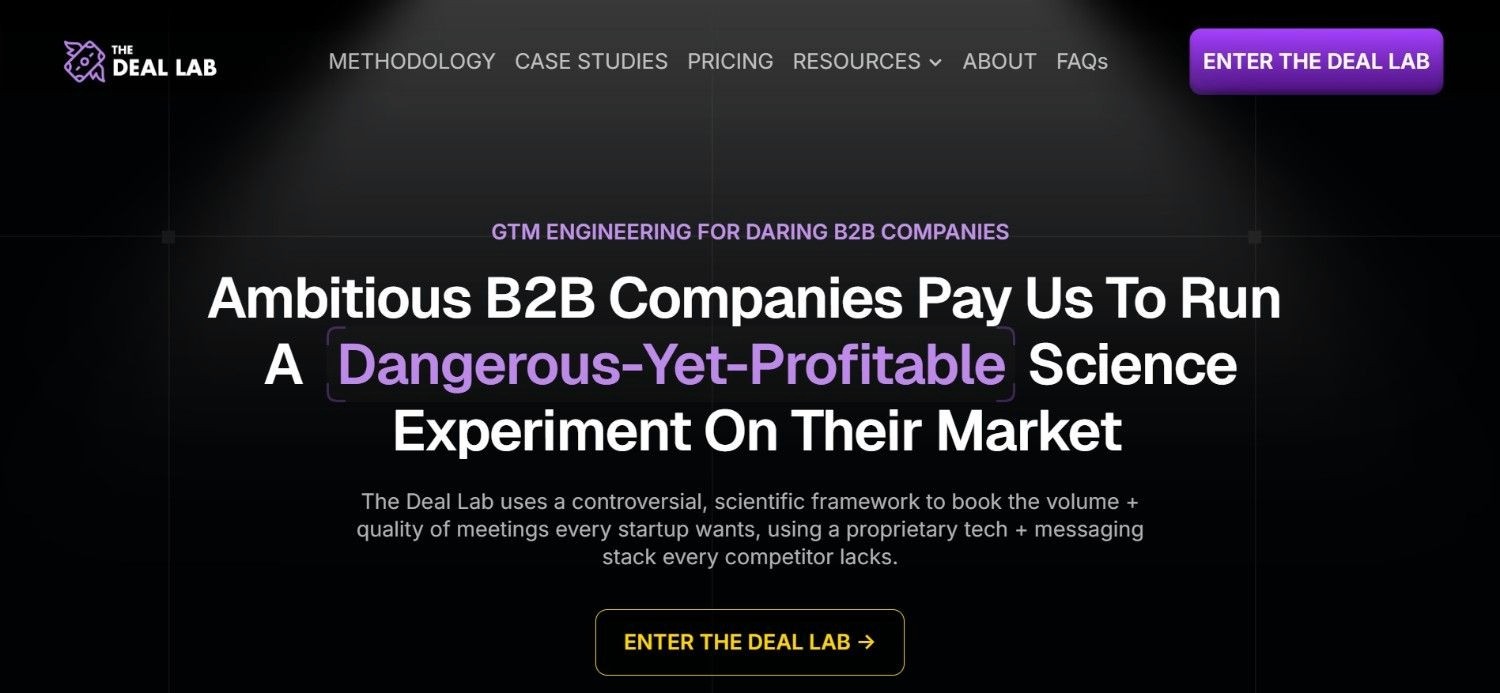
Where The GTM Engineering Company builds durable infrastructure, The Deal Lab plays a deliberately different game. Positioning itself as a B2B revenue agency built around finding message-market fit, the firm runs what it describes as a scientific experimentation framework designed to book the volume and quality of meetings most startups struggle to generate on their own.
Their pitch is explicitly about testing and proving an approach works before scaling the spend behind it, using a proprietary tech and messaging stack that the firm positions as a competitive edge.
This experimentation-first posture makes The Deal Lab a useful fit for companies that are still uncertain about their core messaging and want fast, structured validation rather than a long strategic engagement.
Core Services
Message-market fit testing through structured, repeatable experiments
Proprietary outbound tech and messaging stack execution
Meeting volume and quality optimization for early pipeline generation
GTM engineering support layered on top of outbound experimentation
Pros
Strong focus on validating messaging before scaling spend
Experimentation framework reduces guesswork in early positioning
Useful for startups still iterating on their core value proposition
Cons
Less suited to companies that already have validated messaging and need infrastructure rather than experimentation
Marketing language leans heavily on bold claims, so buyers should request concrete case data before signing
Why It Stands Out
The Deal Lab occupies a distinct niche among go-to-market agencies in the United States: rather than assuming a strategy works and building around it, the firm treats positioning itself as a hypothesis to be tested.
For founders who are not yet confident in their messaging, that discipline can save months of wasted outbound spend.
3. Frontal
Best For: B2B companies at $3M or more in ARR that want a revenue system built once and then either taken in-house or run on an ongoing basis.
Overview
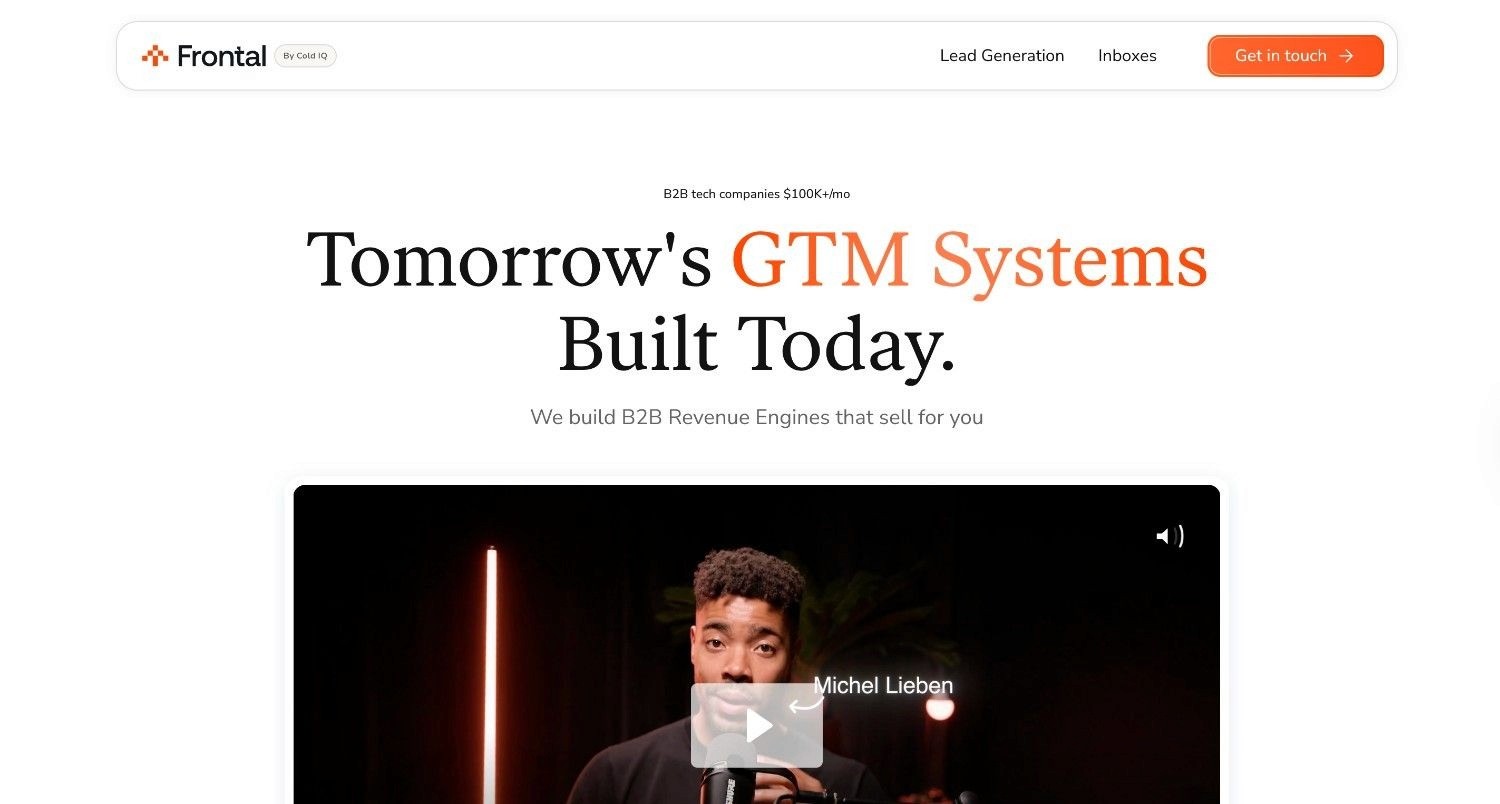
Frontal builds what it calls a “GTM flywheel” system, spanning a mix of channels like outbound, paid ads, and content. The model is designed around a clear handoff point: build the system, then either transfer it fully in-house within 90 days or have Frontal's own operators continue running it.
This dual-path structure sets Frontal apart from agencies that either lock clients into a permanent managed-services relationship or disappear entirely once a project wraps.
The firm has worked with a recognizable roster of B2B and AI-native companies, and its service lines split cleanly into GTM engineering, ads engineering, and content engineering, giving clients a menu rather than a single bundled package.
Core Services
AI-native GTM engineering covering outbound infrastructure and automation
Ads engineering for paid acquisition tied to revenue outcomes rather than impressions
Content engineering designed to support demand generation at scale
Optional in-house transition after a defined 90-day build period
Pros
Flexible handoff model gives clients a choice between ownership and ongoing management
Coverage across outbound, paid, and content rather than a single channel
Strong, recognizable client roster across B2B and AI-native companies
Cons
Positioned for companies already at meaningful revenue scale, which makes it a weaker fit for pre-revenue or very early-stage startups
Breadth across three service lines can mean less specialization depth than a single-channel specialist
Why It Stands Out
Frontal's defined build-then-choose model is a genuinely useful structure for companies that are unsure whether they want to manage a revenue system internally or keep an outside operator running it.
Few American go-to-market firms make that choice this explicit upfront.
4. Growth Alliance
Best For: Established B2B companies between $5M and $100M in ARR that need senior operators embedded for a fixed, intensive sprint.
Overview
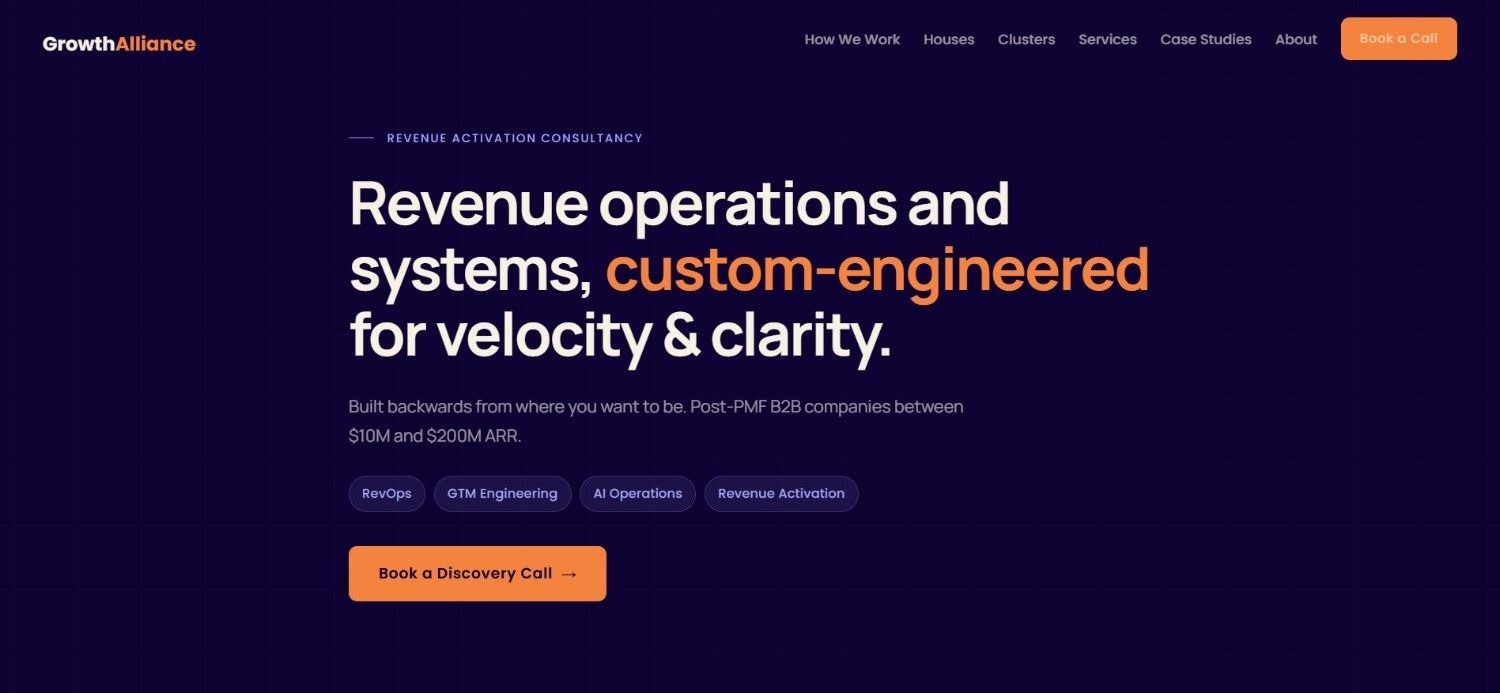
Growth Alliance positions itself as a revenue activation consultancy that custom-engineers go-to-market systems, revenue operations, and outbound infrastructure for companies that have already found product-market fit and are looking to scale with more precision.
The firm's model centers on embedding senior operators directly into a client's team for 90-day sprints, building infrastructure the company keeps permanently rather than renting an ongoing service.
Their service lines span outbound engine design, revenue operations consolidation, GTM system architecture, account-based and demand generation programs, and AI-driven workflow automation.
This gives Growth Alliance one of the broader service footprints among the firms on this list.
Core Services
Outbound engine design with deliverability-first sequencing and automated warm-up systems
Revenue operations consolidation across data, process, and tooling into a single source of truth
GTM system architecture aligning sales, marketing, and operations
Account-based and demand generation program deployment
AI-driven workflow automation to reduce manual operational work
Pros
Senior, embedded operators rather than a junior account team
Fixed 90-day sprint structure makes engagements easy to scope and evaluate
Broad service coverage spanning outbound, RevOps, and demand generation in one engagement
Cons
Positioning toward $5M to $100M ARR companies makes it a less natural fit for pre-seed or seed-stage startups
The breadth of services on offer may require more coordination from the client side than a narrowly scoped specialist
Why It Stands Out
Growth Alliance's embedded, fixed-sprint model gives mid-market B2B companies a way to access senior GTM and RevOps talent without a long-term retainer commitment.
This is a meaningfully different structure from the open-ended engagements common elsewhere in this category.
5. OneGTM
Best For: Early and growth-stage technical teams that want direct access to a single experienced GTM engineer rather than an account team.
Overview
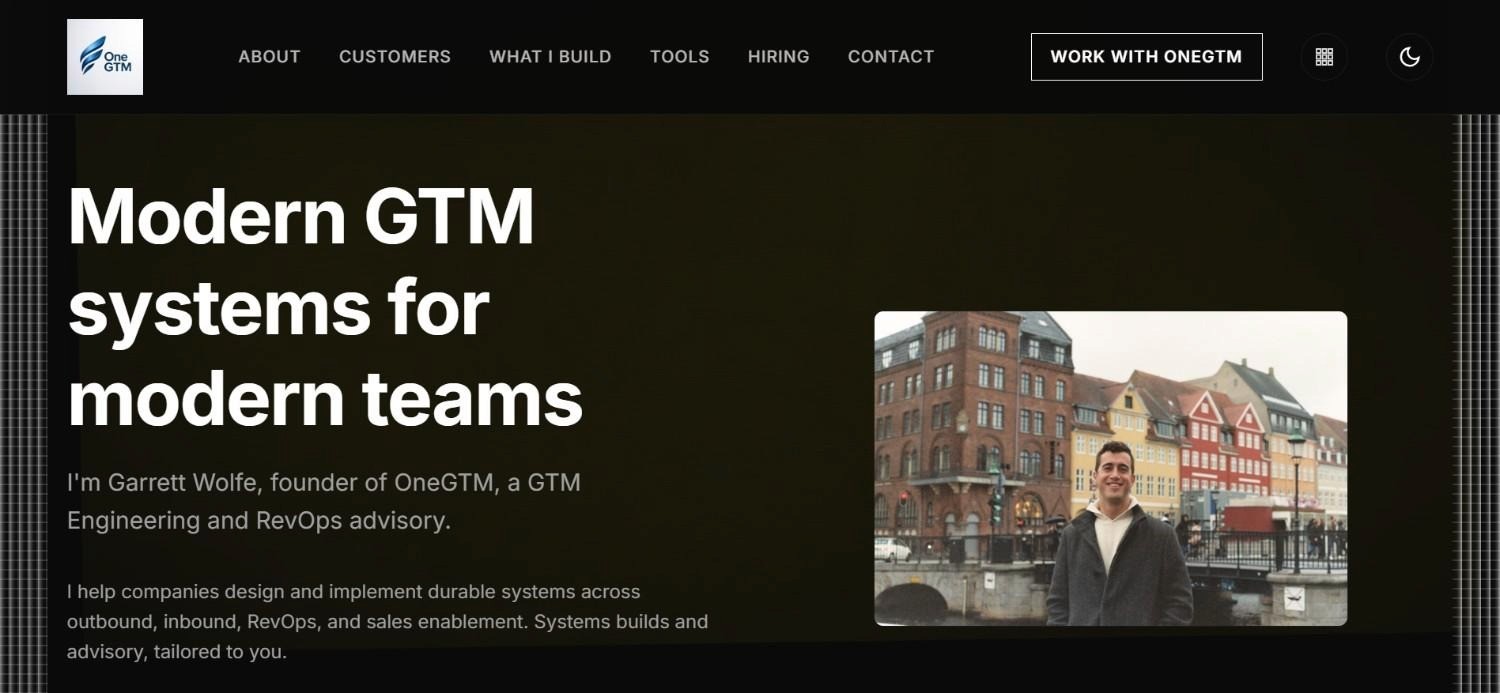
OneGTM is founded by Garrett Wolfe, an early employee at Unify and a top voice in the email outbound space – who also helped build that company's outbound and GTM infrastructure from the ground up before launching his own advisory practice.
While larger firms on this list deploy account teams and delivery staff, OneGTM is explicitly a solo-operator model, offering systems builds and advisory work across outbound, inbound, RevOps, and sales enablement.
Wolfe holds ‘Clay Solutions’ Partner status and is also listed as an OutboundSync agency partner, both signals of genuine hands-on technical depth in the modern signal-driven GTM toolset rather than a generalist label applied after the fact.
Core Services
Outbound and inbound systems builds using Clay, n8n, and modern email infrastructure tooling
RevOps advisory and systems design tailored to early and growth-stage companies
Sales enablement infrastructure built alongside outbound and inbound systems
Direct, founder-level advisory without a layered account team
Pros
Direct access to deep, hands-on technical expertise without account management layers
Clay Artisan Partner status signals genuine certification, not marketing language
Lean structure tends to produce faster decision-making during the engagement
Cons
Solo-operator capacity naturally limits how many clients can be served simultaneously
Less suited to companies needing a large delivery team or multi-channel execution at scale
Why It Stands Out
Among go-to-market agencies in the United States, OneGTM represents the clearest example of the solo-operator trend reshaping this category.
For technical teams that want a builder rather than a managed-services layer, that directness is the entire value proposition.
6. Infinite Skills

Best For: Small B2B teams that need a steady supply of qualified leads sourced from real buying signals rather than purchased lists.
Overview
Infinite Skills occupies the narrowest niche on this list, and that narrowness is the point. The firm uses Clay's data integrations to identify and deliver qualified prospects based on actual buying signals, positioning itself purely as a lead delivery operation rather than a full-stack GTM partner.
Their pitch is straightforward: stop wasting sales time on dead-end leads and focus exclusively on opportunities with real conversion potential.
This single-purpose focus makes Infinite Skills a reasonable option for smaller B2B teams whose core constraint is lead quality rather than strategy, messaging, or CRM architecture.
Core Services
Signal-based prospect identification using Clay's intelligent data integrations
Qualified lead delivery filtered against buying-intent criteria
Ongoing lead supply rather than a one-time list-building project
Pros
Simple, narrowly scoped offering that is easy to evaluate against a single metric
Signal-based sourcing avoids the inefficiency of static, purchased contact lists
Accessible entry point for smaller teams not ready for a full GTM engagement
Cons
No visible strategic layer covering messaging, positioning, or CRM architecture
Limited public information on pricing, case studies, or team structure compared to other firms on this list
Why It Stands Out
Infinite Skills is the most narrowly focused firm among the best GTM agencies in the US covered here, built around a single deliverable rather than a broader system.
For teams whose only real gap is lead quality, that focus can be exactly what is needed, though most growing B2B companies will eventually need a partner covering more of the stack.
Red Flags to Watch Out For When Hiring a GTM Agency
Choosing the wrong partner is worse than choosing no partner.
Here are the warning signs that you need to watch out for, during the evaluation process:
1. They can’t show documented systems from past clients
Every legitimate GTM engagement should produce documentation: SOPs, Loom walkthroughs, field mapping guides, workflow logic notes.
If an agency cannot show you anonymized examples of what that looks like, assume it does not exist.
2. Their case studies are vague
"We improved pipeline efficiency" and "we helped this company scale" are not results. Specific outcomes look like this: research time reduced from two and a half hours to fifteen minutes per account, or eighteen thousand leads processed for under forty dollars in enrichment costs.
If the numbers are not there, be skeptical.
3. They start with the tools, not the problem
An agency that leads with "we use Clay and HubSpot and Instantly" before they have asked about your ICP, your sales cycle, or your current bottlenecks is selling a solution before they understand the problem.
The best go-to-market agencies in the United States start with the business question, not the tech stack.
4. They promise results in unrealistic timeframes
GTM infrastructure takes time to build and compound. Any partner that promises significant pipeline impact in two weeks is either overstating what they will do or underestimating how long good systems take to produce results.
A pitch saying “early signals in the first 30 days” is more realistic, compared to a pitch that goes “transformed pipeline in 14 days” – or something similar.
5. They resist knowledge transfer
Some agencies are incentivized to keep clients dependent.
If a partner is reluctant to train your team, document their processes, or explain how workflows are built, that reluctance has a commercial reason behind it.
The best US GTM agencies actively invest in making clients self-sufficient.
Build Your GTM Engine with The GTM Engineering Company
Most American go-to-market firms will sell you a campaign that runs while the retainer is active and disappears the moment it ends. That's a rented result, not an asset, and if you're a VC-backed startup trying to prove a repeatable revenue motion, renting your pipeline every month is not a position investors want to see you in.
The GTM Engineering Company builds the opposite: an evergreen enrichment layer in Clay that keeps every CRM record current, signal-based outbound that fires on real triggers like funding rounds and hiring surges instead of static lists, and AI scoring that routes rep activity automatically. All built inside your own stack, not a vendor-controlled environment. Every workflow ships with a Loom walkthrough and a written SOP, so the system is yours to run the day the engagement ends, not something you keep paying to access.
Founded by Y Combinator S18 alum Jorge Macías, the firm has built and shipped GTM systems for more than 100 companies, with transparent pricing starting at $4,000/month and weekly working sessions instead of static monthly reports.
Stop renting campaigns and start owning infrastructure. Book a call with The GTM Engineering Company here to see how fast a system like this can be running in your stack.
Frequently Asked Questions
What is a GTM agency?
A GTM agency is a partner that helps companies take a product to market and build repeatable revenue from it. Their scope typically covers some mix of ICP definition, messaging validation, channel strategy, tech stack implementation, and pipeline generation. The strongest go-to-market agencies in the United States build the execution layer alongside strategy rather than leaving implementation to the client.
How much does a GTM agency cost in the US?
Costs vary significantly based on scope and delivery model among top GTM agencies in the USA. Solo-operator or fractional engagements can start around $3,000 to $4,000 per month. Embedded sprint models and full-stack agencies typically run $5,000 to $15,000 per month, particularly for firms working with companies already at meaningful revenue scale. In almost every case, the fully loaded cost compares favorably to hiring an equivalent in-house team from scratch.
How is a GTM agency different from a traditional marketing agency?
A traditional marketing agency tends to specialize in executing specific channels such as SEO, paid media, content, or social. A GTM agency takes a broader view, starting with the fundamental questions of who to target, how to position the product, and which channels are most likely to produce revenue. American go-to-market firms increasingly fold technology implementation and sales alignment into that scope as well, not just marketing execution.
Should I choose a full-stack GTM agency or a narrow specialist?
It depends on whether your constraint is broad or specific. If your core problem is unreliable lead quality alone, a narrowly focused firm like Infinite Skills may solve it directly. If you need a complete revenue engine built from scratch, spanning outbound, scoring, and CRM architecture together, a full-stack US B2B GTM agency like The GTM Engineering Company is the stronger fit. Mismatching a narrow specialist to a broad problem, or a broad generalist to a narrow problem, is one of the most common reasons GTM engagements underdeliver.
How long does it take to see results from a GTM agency?
For infrastructure-led engagements, early signals typically appear within the first 30 days, including cleaner data, sharper ICP targeting, and initial outreach activity. For experimentation-focused firms testing messaging, validated signal can sometimes emerge faster, though scaling what works still takes additional time. A fully functioning system with documented workflows and measurable pipeline impact across most US GTM agencies typically takes 60 to 90 days to reach steady state.
Is a GTM agency worth it for an early-stage startup?
Often yes, provided the agency understands early-stage constraints rather than applying enterprise timelines and budgets to a much smaller team. Building outbound and CRM infrastructure incorrectly at the seed stage is expensive to unwind later. The right B2B GTM agency in the USA for an early-stage company is one that ships quickly, documents everything, and leaves the founding team capable of running the system independently as headcount grows.