

Key Takeaways (TL;DR)
If you are a founder or revenue leader without the time to read the full breakdown, here is what you need to know:
What ABM agencies actually do?: The best ABM agencies do not just hand you a target account list and a sequence template. They identify your highest-fit accounts, test what messaging actually resonates with those buyers, build the infrastructure to reach them across multiple channels, and stay accountable to pipeline outcomes rather than activity metrics.
Why do most ABM programmes underperform?: Most B2B teams treat ABM as a volume play with better targeting. The result is outreach that reaches the right company but says the wrong thing, or says the right thing to the wrong person. Getting message-market fit right before scaling any campaign is the step most teams skip.
Selection principle: Match the agency to your biggest constraint. If your problem is that you do not know what message breaks through to your ICP, start with a specialist in message-market fit. If your problem is that you lack the infrastructure and systems to run ABM at scale, start with a GTM engineering firm. Mixing up those two needs leads to expensive mismatches.
Stage matters: An ABM agency built for enterprise sales cycles will struggle with a growth-stage team that needs to move quickly and iterate on messaging in weeks. Always prioritize agencies with a track record at your specific stage and deal size.
Top ABM Agencies in 2026 at a Glance
Agency | Primary Focus | Best For |
Growthspree | Full-Stack ABM & Demand Generation | Growth-stage B2B SaaS and mid-market companies |
The GTM Engineering Company | GTM Engineering & Revenue Infrastructure | VC-backed B2B SaaS (Seed to Series B) transitioning from founder-led to team-operated sales |
The Deal Lab | Message-Market Fit & Outbound Experimentation | Companies running ABM who need to test and find what messaging resonates |
oneGTM | GTM Engineering & ABM Infrastructure | B2B companies needing technical go-to-market systems alongside ABM strategy |
Apero Advisors | GTM Engineering & ABM Advisory | Growth-stage companies needing cross-functional sales, marketing, and ops expertise |
What Is an ABM Agency?
Account-based marketing is a B2B strategy where sales and marketing align on a defined set of target accounts and coordinate outreach across multiple channels to engage them. Rather than generating broad lead volume and sorting for quality afterward, ABM concentrates resources on the accounts most likely to convert and builds a coordinated, personalized experience for each one.
An ABM agency is an external partner that builds and runs that programme. Their scope typically covers ICP definition and account list development, positioning and message testing, channel strategy across email and LinkedIn and paid, tech stack configuration, outreach execution, and performance reporting tied to pipeline.
The best ones do not hand over a strategy document and leave; they stay inside the programme, iterate based on what the data shows, and remain accountable to whether it produces results.
The category has matured significantly in recent years. Three years ago, hiring one of the best ABM agencies largely meant getting help with account list segmentation and sequence templates. That work still exists, but it is no longer where the highest-leverage activity happens.
In 2026, the agencies achieving the best results are using a more specific approach. They follow these three main practices:
They test messaging: They validate their messaging theories against real target accounts before committing to scaling those campaigns.
They build better infrastructure: They use enrichment and signal-based tools to identify the right moment to reach out to prospects.
They integrate channels: They manage outbound, paid advertising, and content as a single, coordinated system rather than running each channel separately.
How the ABM Market Has Changed in 2026?
1. Message-market fit has become the first problem to solve
Most ABM campaigns fail not because the targeting is wrong but because the messaging does not resonate. The accounts are right; the message is off.
The best B2B ABM agencies in 2026 treat message-market fit as a prerequisite before scaling any campaign.
That means running structured experiments on a small sample of target accounts, testing multiple message angles.
All of this helps in identifying what actually generates responses before committing a budget to a single approach at scale.
The playbook of building a static account list and blasting it with the same sequence has become both less effective and more damaging to deliverability.
The agencies producing strong results in 2026 build systems that trigger outreach based on real events: a funding announcement, a new hire in a buying role, a technology change, a competitor review – signals that indicate an account is in an active buying moment.
Reaching the right account at the right time with the right message is the combination that actually produces replies.
A few years ago, most teams ran outbound, paid advertising, and content as separate motions with separate teams and separate reporting. The top ABM agencies in 2026 build integrated programmes where each channel reinforces the others.
The content warms accounts before outbound reaches them, while implementing LinkedIn ads helps them maintain presence while sequences run.
Ultimately, the whole system is measured against a single pipeline target rather than channel-level metrics.
A growing number of B2B companies have been burned by agencies that built campaign infrastructure in their own tools and accounts, then left when the retainer ended.
The standard is shifting: the best account-based marketing agencies now build inside the client's stack, document everything – and in some cases, also invest in making the client's team capable of operating the programme independently.
Best ABM Agencies in 2026: Full Reviews
1. Growthspree
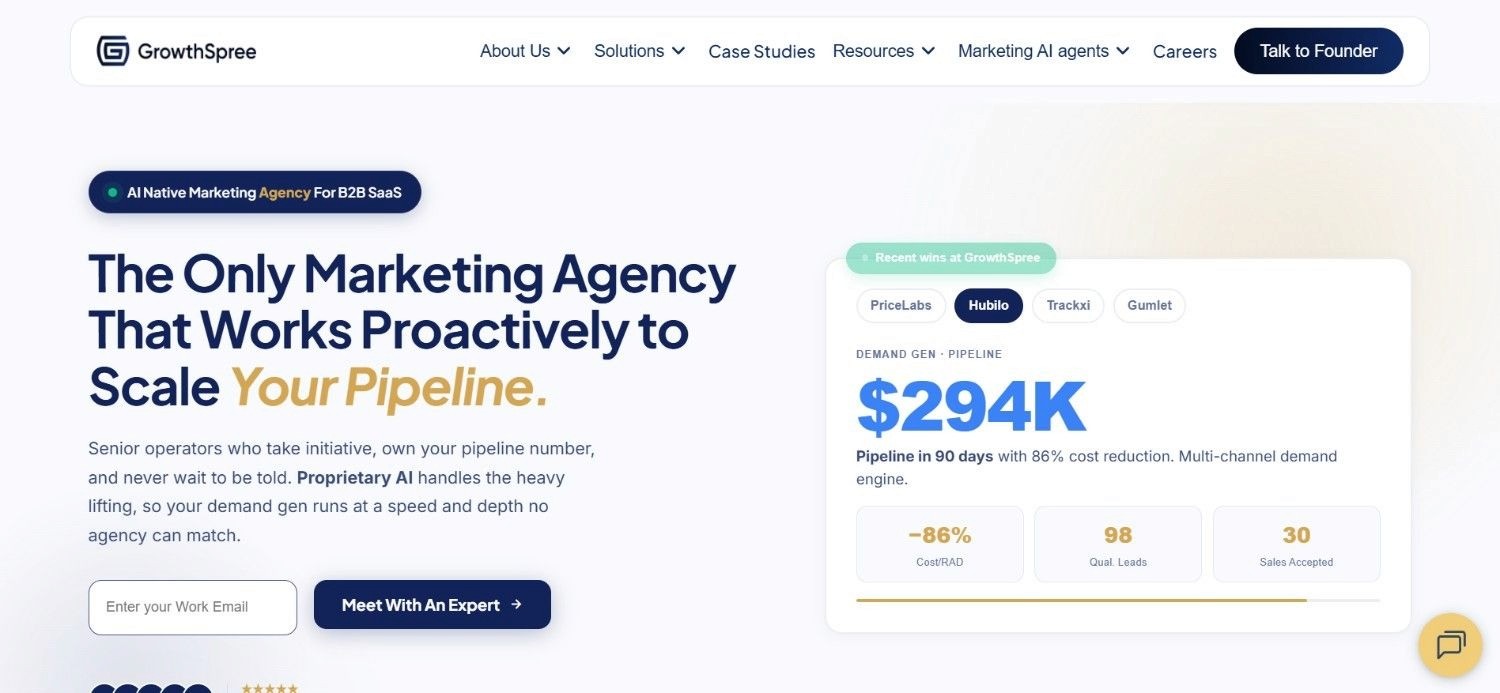
Best For: Growth-stage B2B SaaS companies and mid-market teams that need a full-stack ABM partner to own the programme end-to-end, from ICP strategy through to multi-channel execution and pipeline reporting.
Overview
Growthspree is a demand generation and ABM agency built for B2B companies that need account-based marketing treated as a revenue programme rather than a marketing activity.
While most agencies deliver either strategy or execution in isolation, Growthspree takes ownership across the full ABM lifecycle: defining the ICP, building the target account list, designing the campaign architecture, executing across email and LinkedIn and paid channels, and reporting performance against pipeline outcomes.
The agency works with growth-stage SaaS companies and mid-market teams that have validated product-market fit and need to build a repeatable ABM motion to replace or supplement founder-led sales.
Their approach connects every campaign decision back to the target account list and the buying journey of the specific accounts being pursued, rather than running generic outreach with account-level personalization layered on top.
Core Services
Full-stack ABM programme design and execution covering ICP definition, account list development, multi-touch campaign architecture, and coordinated outreach across email, LinkedIn, and paid channels
Outbound strategy with messaging matched to the specific buying context of each target account segment, designed to generate qualified pipeline rather than raw response volume
ABM performance reporting tied to pipeline and revenue outcomes, with regular campaign reviews and iteration cycles based on what the data shows rather than what was planned at the start of the engagement
Pros
Full programme ownership from strategy through execution and reporting, reducing internal coordination overhead for the client team
Pipeline-accountable model where agency performance is measured against revenue outcomes rather than activity volume
Strong fit for growth-stage B2B companies that need to build an ABM motion without hiring a full internal ABM function
Multi-channel approach that coordinates outbound, LinkedIn, and paid as a single integrated programme rather than separate motions
Cons
Custom pricing without published tiers means budget evaluation requires a direct conversation before shortlisting
Why It Stands Out
Growthspree stands out among the best ABM agencies in 2026 for combining full programme ownership with pipeline accountability in a single engagement model.
For growth-stage B2B companies that have struggled to make ABM work with purely internal resources or with agencies that deliver strategy without execution, Growthspree's integrated ownership model addresses the core coordination problem that most ABM programmes run into.
The agency does not hand over a target account list and a sequence – it builds and runs the programme alongside the client team and stays accountable to whether it produces pipeline.
2. The GTM Engineering Company

Best For: VC-backed B2B SaaS companies from Seed to Series B that need a scalable revenue infrastructure built and owned internally, without the ramp time or cost of hiring a full in-house GTM team.
Overview
The GTM Engineering Company approaches go-to-market problems the way engineers approach systems problems: with documented architecture, automated workflows, and infrastructure built to run inside the client's own stack from day one.
Founded by Jorge Macías, a Y Combinator S18 alumnus who has built GTM systems for over 100 companies, the firm is not a conventional ABM agency.
While most partners in this category deliver strategy, content, or campaign management, The GTM Engineering Company builds the underlying revenue infrastructure: the data architecture, signal-based outbound systems, AI scoring models, and operational workflows that make a sales motion work at scale without adding headcount.
For a VC-backed startup managing the transition from founder-led sales to a team-operated motion, this addresses the specific gap most companies at that stage face: the need for enterprise-grade revenue infrastructure without the hiring timeline or headcount cost that typically comes with it.
Every engagement ends with the client team capable of operating and extending the infrastructure independently.
Core Services
Full-stack GTM architecture: covering design and implementation of the complete data flow – from CRM configuration, contact-to-account linkage, lifecycle stage logic, and attribution modeling, with manual processes automated wherever the accuracy of automation meets the required bar
Signal-based outbound infrastructure: that triggers sequences based on real purchasing intent: a new hire in a buying role, a technology change, a funding announcement, a traffic surge – so outreach reaches accounts at the right moment rather than on a fixed schedule
AI scoring architecture: that combines ICP fit with live intent signals into a tiered scoring model pushed directly into the CRM, so reps see which accounts to prioritize without interpreting raw data manually
Evergreen enrichment infrastructure: built in Clay that keeps every CRM record current across firmographic, technographic, and contact data, so data decay does not degrade outbound quality over time
Inbound intelligence layer: that auto-generates pre-meeting briefs for every booked call, delivering enriched company data, funding stage, tech stack, and traffic signals to the rep in Slack ahead of each conversation
Pros
Engineering-led execution that builds compounding infrastructure rather than time-limited campaigns; the systems continue producing value after the engagement ends
Full system ownership from day one: everything built inside the client's own stack, documented with Loom walkthroughs and written SOPs, and transferable when the engagement concludes
Transparent pricing starting at $4,000/month with no hidden retainer structures, making early-stage budget planning realistic before a scoping conversation
Weekly working sessions inside the client's own CRM and tooling ensure continuous alignment rather than monthly review calls disconnected from the live programme
Cons
Weekly session model requires consistent client availability; not suited for companies that want a fully passive engagement where the agency runs everything independently
Why It Stands Out
The GTM Engineering Company is the only firm in this comparison that combines fractional GTM engineering depth, transparent tiered pricing, and full system ownership in a single engagement model. Most ABM agencies either build strategy without touching infrastructure or build infrastructure without client documentation.
The GTM Engineering Company does both, and explicitly builds toward the moment the client no longer needs the retainer.
For VC-backed B2B SaaS companies at Seed to Series B that need to replace founder-led sales with a system the team can operate, The GTM Engineering Company is one of the most operationally specific choices among the best ABM agencies in 2026.
3. The Deal Lab
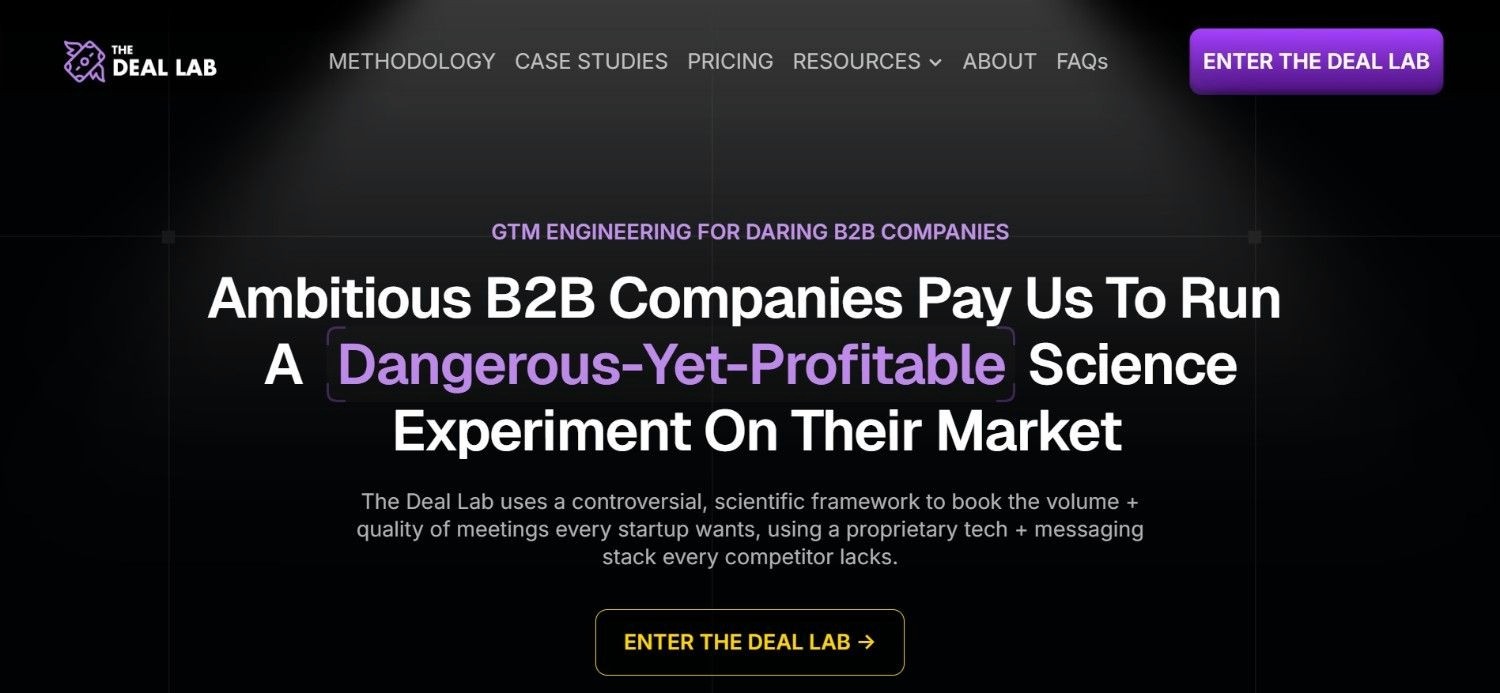
Best For: B2B companies running ABM campaigns that need to systematically test and identify what messaging resonates with their target accounts before scaling outreach investment.
Overview
The Deal Lab is a specialist ABM and outbound agency run by Kellen Cassaber, built around a specific problem that most ABM programmes underinvest in: message-market fit. Rather than jumping straight to outreach at scale, The Deal Lab starts with structured experimentation – testing multiple messaging hypotheses against a sample of target accounts to identify what actually generates responses before any budget is committed to scaling a single approach.
Their founder, Kellen is a recognized practitioner in outbound mechanics, email automation, and breaking into new markets with B2B outreach.
For companies that know their ICP but have not been able to identify what message breaks through to those accounts, The Deal Lab addresses exactly that gap.
Core Services
Message-market fit identification through structured campaign experimentation, testing multiple messaging approaches against the same target account set to determine what generates responses before any single message is scaled
Outbound strategy and email automation covering sequence architecture, deliverability configuration, personalization logic, and response rate optimization for ABM campaigns
Market entry strategy for B2B companies moving into new verticals or geographies, covering positioning, messaging angles, and the outreach approach most likely to establish a foothold before scaling spend
Pros
Genuine specialism in message-market fit – a critical ABM capability that most agencies treat as secondary to execution volume
Deep expertise in email automation and outbound mechanics from a practitioner who has built and run these systems across multiple markets and ICPs
GTMcafe community provides additional peer learning and go-to-market practitioner access alongside the agency engagement
Strong fit for companies that need to validate messaging before committing budget to at-scale ABM outreach
Cons
More focused on outbound messaging and email-led ABM than on full multi-channel programme execution including paid advertising and content coordination
Boutique model means capacity may be more limited than larger ABM agency partners with multiple delivery teams
Less suited for companies that want a single partner to own every component of an ABM programme, from ICP research through to paid channel management
Why It Stands Out
The Deal Lab stands out for treating message-market fit as the first problem to solve, not an afterthought. Most ABM agencies jump to execution and optimize from there.
Kellen's approach of testing what actually resonates with target accounts before committing to scale is a methodologically sounder starting point – and one that produces better reply rates and lower wasted spend on outreach that reaches the right accounts but says the wrong thing.
For companies running ABM campaigns with low response rates, The Deal Lab is one of the most targeted choices among the best ABM agencies for diagnosing and fixing that specific problem.
4. oneGTM
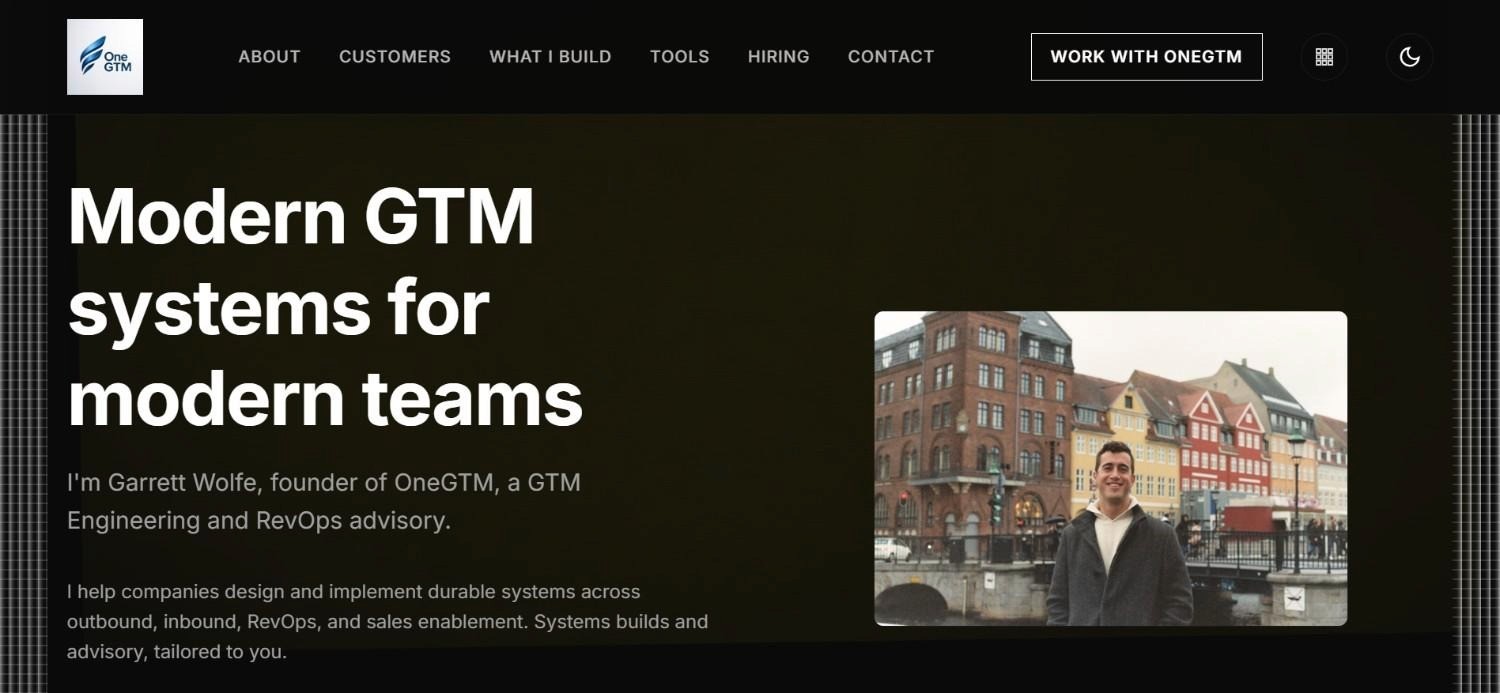
Best For: B2B SaaS companies that need ABM supported by strong GTM infrastructure, including outbound systems, CRM architecture, and the technical foundation that makes account-based campaigns run accurately and at scale.
Overview
oneGTM is a go-to-market engineering and ABM agency that brings a technical lens to account-based marketing. Rather than focusing purely on campaign strategy, oneGTM builds the underlying infrastructure that makes ABM programmes run accurately at scale: outbound systems, CRM architecture, data enrichment pipelines, and signal-based sequencing that triggers outreach based on real buying intent rather than static lists.
What sets them apart is the combination of GTM engineering depth and ABM strategy in a single engagement. Most agencies handle one or the other. oneGTM connects both, which matters when underperforming ABM campaigns trace back to broken data and infrastructure rather than a messaging or targeting problem.
For companies where the underlying data, CRM configuration, and outbound automation are broken, and better targeting is layered on top of a broken system, oneGTM addresses the root cause.
Core Services
GTM engineering and outbound infrastructure design covering CRM configuration, enrichment tooling, sequencing platforms, and the technical stack that makes ABM campaigns run accurately and at scale
Account-based marketing strategy grounded in market research and ICP analysis, with campaign architecture built around the specific buying journeys of the target account set
Go-to-market operations consulting covering the systems, processes, and measurement frameworks that connect ABM campaign activity to pipeline and revenue outcomes
Pros
GTM engineering expertise that connects ABM strategy to the technical infrastructure needed to run campaigns accurately, not just the strategic layer
Founder with genuine market research credibility through the State of GTM Engineering report, indicating a data-grounded approach to programme design
Strong fit for companies that need both ABM strategy and the operational systems to execute it, without managing two separate agency relationships
Relevant for organizations that want a partner who understands the GTM engineering landscape and can inform tooling decisions alongside campaign strategy
Cons
GTM engineering focus may be more than necessary for companies that primarily need help with messaging and outreach execution rather than systems buildout
Boutique positioning means capacity constraints may apply for high-volume programme management across multiple simultaneous campaigns
Less specialized in paid channel ABM execution compared to agencies with dedicated LinkedIn and programmatic advertising capabilities
Why It Stands Out
oneGTM stands out for combining ABM strategy with a GTM engineering perspective that most account-based marketing agencies lack.
For B2B companies whose ABM programmes are underperforming because the underlying infrastructure is broken – imagine CRM data being unreliable, your outbound automations all disconnected while the scoring models are absent.
oneGTM addresses the root cause of these issues rather than adding more outreach volume on top of a system that was never built to support it.
5. Apero Advisors
Best For: Growth-stage B2B companies that need GTM engineering applied to their ABM programme, with a partner who brings cross-functional experience across sales, marketing, and growth operations.
Overview
Apero Advisors is a GTM engineering and advisory firm founded by Michael Slaus Lawson, who brings six years of experience spanning sales operations, marketing operations, and growth strategy.
The agency positions itself at the intersection of go-to-market engineering and account-based marketing, helping B2B companies build systematic ABM programmes rather than running disconnected campaigns that marketing and sales execute independently of each other.
Their multichannel approach integrates sales operations, marketing operations, and revenue growth strategy into a unified GTM programme.
That cross-functional perspective matters for ABM: most programmes fail not because the campaign design is wrong but because sales and marketing are not working from the same account intelligence, the same targeting criteria, or the same definition of what a good response looks like.
Michael's background across all three functions gives Apero a coherent view of where those misalignments typically occur and how to fix them.
Core Services
Go-to-market engineering advisory covering the systems, processes, and operational infrastructure that support ABM execution at scale, from CRM to outbound tooling to reporting frameworks
Account-based marketing programme design combining ICP analysis, target account list development, multi-channel campaign architecture, and messaging strategy into a coordinated programme with clear ownership across sales and marketing
Sales and marketing alignment work that bridges the gap between marketing's ABM campaign execution and sales' account engagement, ensuring both teams are operating from the same account intelligence and agreed targeting criteria
Pros
Founder’s 6 years of cross-functional experience across sales, marketing, and growth operations gives Apero a broader view of GTM than most ABM-only specialists
Sales and marketing alignment focus addresses one of the most common failure modes in ABM programmes, where marketing generates account awareness that sales never follows up effectively
GTM engineering lens connects ABM strategy to the operational systems that make campaigns run accurately and produce measurable results
Strong advisory model for growth-stage companies that need strategic guidance backed by real operational experience rather than theory
Cons
Advisory model may be less suited for companies that primarily need execution support rather than strategic guidance and programme architecture
Smaller firm size means capacity for high-volume, simultaneously-running ABM programmes may be more constrained than larger agency partners
Less specialized in paid channel ABM execution; primarily focused on strategy, operations, and outbound-led ABM rather than LinkedIn advertising or programmatic display at scale
Why It Stands Out
Apero Advisors stands out for its founder, Michael Slaus Lawson's rare combination of sales operations, marketing operations, and growth strategy experience.
Most ABM agencies specialize in one side of the equation: either marketing execution or sales enablement. Apero brings both together, which matters for ABM programmes where the typical failure mode is a disconnect between how campaigns are built and how sales teams actually engage with the accounts they surface.
For growth-stage companies where alignment between sales and marketing is the core problem, Apero Advisors is one of the more targeted choices among the best ABM agencies in 2026.
Red Flags to Watch Out For While Hiring an ABM Agency?
Choosing the wrong partner is worse than choosing none at all.
Here are the warning signs worth watching for during the evaluation process:
1. They skip message testing and go straight to scale
An agency that builds your target account list and immediately launches outreach at volume, without any structured testing of what messaging resonates, is optimizing for activity rather than results.
The first question a good top ABM agency asks is not "how many accounts should we target?"
It is "what message actually breaks through to these buyers?" If that question is not on the table in the first conversation, it should be.
2. Their case studies are vague
"We improved the pipeline for a SaaS company" is not a result. Specific outcomes look like: response rates moved from 2% to 14% after switching to a problem-led message, or a new market generated 18 qualified meetings in the first 60 days.
If the numbers are not there, ask directly. If a clear answer does not come back, that is worth noting.
3. They build in their own tools, not yours
Some ABM agencies run campaigns from their own sending domains, their own LinkedIn ad accounts, and their own CRM instances. When the engagement ends, the client has nothing transferable.
The best agencies build inside the client's stack, document everything, and leave the team capable of operating the programme independently.
4. They cannot explain what they will measure
If an agency cannot tell you specifically how they will define success before the engagement starts: which metrics, which reporting cadence, which outcomes connect to pipeline – that is not a pipeline-accountable partner. It is an activity-accountable one.
The best ABM agencies in 2026 agree on commercial outcomes at the start and report against them throughout.
5. They start with tactics, not the problem
An agency that leads with "we use Clay and LinkedIn Sales Navigator and Instantly" before asking about your ICP, your sales cycle, or where your current ABM programme is breaking down is selling a toolkit, not a solution to a business problem.
The right starting point is always the business question – and the tools follow from there.
Frequently Asked Questions
What is account-based marketing?
Account-based marketing (ABM) is a B2B strategy where sales and marketing concentrate resources on a defined set of high-fit target accounts rather than generating broad lead volume. Instead of producing leads and sorting for quality, ABM identifies the right accounts first and builds coordinated, personalized outreach across multiple channels to engage each one.
What is an ABM agency?
An ABM agency is a specialist firm that helps B2B companies design and run account-based marketing programmes. Their scope typically covers ICP definition, target account list development, message testing, multi-channel campaign execution across email and LinkedIn and paid, and performance reporting tied to pipeline and revenue outcomes. The best account-based marketing agencies do not just hand over a strategy document – they build and run the programme alongside the client team and remain accountable to commercial results.
What should I consider when choosing an ABM agency?
The most important factors are: whether the agency matches your specific constraint (message testing, infrastructure, or full programme ownership); whether they measure performance against pipeline rather than activity; whether their client experience matches your company stage and deal size; how credibly they can speak to the tools your ABM programme will depend on; and whether their strength is messaging strategy or execution depth. Most ABM programme failures come from mismatches on one of those dimensions rather than poor agency quality overall.
How long before an ABM programme produces results?
With the right partner and a clear ICP, early signals appear quickly. Within the first 30 days of a well-structured ABM programme, expect initial message testing results, a refined account list, and first outreach activity. Meaningful pipeline contribution typically materializes within 60 to 90 days. Compounding results; where brand presence in the target account set builds, warm accounts convert more consistently, and the programme develops a self-reinforcing quality – take three to six months to develop.
Do I need an ABM agency if I already have an internal marketing team?
Not necessarily as a replacement; but often as a complement. Internal teams frequently lack the specialized expertise to build certain components of an ABM programme, particularly around message-market fit testing, signal-based outbound infrastructure, or coordinating paid and outbound and content as an integrated motion. An agency that builds capability alongside the internal team – and documents everything so the team can operate independently – often produces better outcomes than either working in isolation. The key question is whether the agency is building transferable infrastructure or keeping the client dependent on the retainer.
What should an ABM agency engagement include as a minimum?
At minimum: a defined ICP with documented reasoning for account selection, a clear message testing process before any campaign scales to volume, a coordinated outreach programme across at least two channels, and a reporting framework that connects campaign activity to pipeline and revenue. If an agency cannot commit to all four of those by the end of the first engagement month, that is worth raising before signing anything.