

Key Takeaways (TL;DR)
Importance: VC-backed startups need RevOps partners who understand funding cycles and automation-first infrastructure, not just tech stacks. The best B2B revenue operations agencies in 2026 combine strategic consulting with hands-on implementation, building systems that ensure your sales pipeline scales from a single founder to a full SDR team without manual data entry or lead leakage.
What to Check: Verify that your agency prioritizes engineering-led architecture over simple system tuning. Confirm they can architect complex integrations across Clay, data providers like Cognism, and your existing CRM. They must handle territory management, round-robin routing, and automated lead enrichment to ensure your CRM remains a reliable "single source of truth" during rapid post-Series A hiring surges.
Most Common Mistake: Many startups hire traditional agencies that deliver PowerPoint decks or optimize existing, broken processes rather than building scalable infrastructure from scratch. Without a modular foundation and complete knowledge transfer, your RevOps systems will break – or create vendor dependency – the moment you add headcount or shift from Seed to Series B.
Where to Find Support: For technical founders needing automation-first GTM systems, The GTM Engineering Company offers fractional support that generates qualified meetings in weeks. For platform-specific needs, HubSpot Elite partners like RevPartners, talent hubs like Aptitude8, or data specialists like Sculpted provide the technical depth required to maintain pristine CRM foundations.
Top B2B Revenue Operations Agencies: At a Glance
Agency | Type | Best For | Key Differentiator |
The GTM Engineering Company | Fractional GTM Engineer | Early-stage SaaS needing systems from scratch | Tool-agnostic infrastructure builds with weekly hands-on sessions |
RevPartners | HubSpot Elite RevOps Partner | Complex HubSpot setups and automation | Largest or near-largest HubSpot partner specializing in revenue operations |
Aptitude8 | Full-Service HubSpot Partner | Complex projects requiring deep talent bench | Talent hub model with product development background and spin-offs |
Sculpted | CRM Data Specialists | Companies prioritizing CRM data quality | HubSpot and Salesforce CRM focus with clients like Nooks and Sendoso |
Go Nimbly | Strategic RevOps Consultancy | Mid-market teams needing strategic guidance | Thought leadership and annual conference (May, New York) |
RevPal | RevOps-as-a-Service | Series A–C SaaS Companies | Diagnostic-first approach with proprietary OpsPal CRM health scoring |
Why B2B Revenue Operations Agencies Matter in 2026
B2B revenue operations agencies align your marketing, sales, and customer success teams around shared systems, data, and goals. They build the infrastructure that makes your go-to-market motion predictable and scalable. This includes CRM architecture, lead routing, data enrichment workflows, attribution modeling, performance dashboards, and process automation that eliminates manual work.
In 2026, the market has shifted decisively away from isolated tactical fixes. B2B SaaS companies juggle disconnected tools like Apollo, ZoomInfo, and Salesforce that produce inconsistent data. McKinsey's 2025 "Rewiring Martech" report found that 47% of martech decision-makers cite stack complexity as their primary barrier to growth. At the same time, they face aggressive growth targets without the budget to scale headcount linearly. This creates demand for engineering-led partners who can unify the tech stack and make GTM systems reliable.
The best firms now operate at the intersection of revenue operations, sales automation, and go-to-market engineering. They handle:
Full RevOps system setup from lead routing to attribution
CRM integration and configuration across HubSpot, Salesforce, and data providers
Automated lead enrichment workflows using scrapers, AI, and API-based triggers
Multi-channel outbound campaign builds with technical setup and messaging frameworks
Performance analytics dashboards for funnel visibility and GTM ROI
Sales process optimization and GTM tech stack architecture
What makes 2026 different is the rise of automation-first execution. Gartner predicts that 65% of B2B sales organizations will have transitioned from intuition-based to data-driven decision making by 2026, merging sales process, data, and analytics into unified operational systems. McKinsey estimates that generative AI and automation tools could unlock $0.8 trillion to $1.2 trillion in incremental productivity across sales and marketing functions – on top of gains already realized from traditional software. Agencies that only optimize existing processes can't compete with firms that build entirely new systems. Companies now expect qualified pipeline in weeks, not quarters, and systems that continue generating results long after the engagement ends.
Specialized RevOps Agencies vs Full-Service Consultancies
Specialized RevOps Agencies
These firms focus exclusively on revenue operations and related automation. They typically have deep expertise in specific platforms like HubSpot or tools like Clay.
Pros:
Deep technical expertise in their chosen platform or methodology
Faster time to value on complex implementations
Stronger community presence and educational content
Often more transparent pricing structures
Cons:
May create platform dependency
Narrower scope if you need broader GTM support
Less strategic consulting on go-to-market positioning
Best for: Companies that already know they need HubSpot optimization, Clay automation, or CRM data quality fixes and want the best technical execution.
Full-Service GTM Consultancies
These agencies combine RevOps infrastructure with broader go-to-market services like ICP research, messaging, and outbound campaign execution.
Pros:
End-to-end GTM support from strategy through execution
Tool-agnostic approach reduces vendor lock-in
Better for companies building systems from scratch
Often include knowledge transfer and documentation
Cons:
May lack depth in specific platform configurations
Longer ramp time to understand your business
Higher investment required for full engagements
Best for: Earlier-stage companies (Seed to Series B) that need to build repeatable revenue infrastructure, not just optimize existing systems.
Many top B2B revops firms now offer hybrid models that blend specialization with broader GTM capabilities. This gives you platform expertise without sacrificing strategic flexibility.
What to Look For in B2B Revenue Operations Agencies
Selection Criteria | What to Look For | Key Questions to Ask |
1. Technical Depth | Evidence of complex, multi-API integrations and custom data enrichment pipelines (e.g., Clay, Cognism) rather than just platform partner badges. | "Can you walk me through your most technically challenging integration or custom workflow?" |
2. Systems vs. Tactics | Agencies that architect new infrastructure if your CRM is a mess, or optimization specialists if you just need to tune existing solid systems. | "Are we just fixing a broken process, or are you architecting the foundation we actually need?" |
3. Knowledge Transfer | Deliverables that include full documentation, training, and maintenance guides to ensure you own the system without ongoing dependency. | "What happens to the infrastructure and our ability to manage it when the engagement ends?" |
4. Automation-First | Proficiency in scrapers, AI enrichment, and signal-based prospecting that layers trigger data to identify high-intent accounts. | "How do you use AI and API connectors to reduce manual research and ship pipeline in weeks?" |
5. Iteration & Transparency | Weekly working sessions and live updates (Slack/Notion) rather than static monthly PowerPoint reports or "reporting theater." | "How often will we actually collaborate hands-on, and what visibility do we have between calls?" |
6. Stage Relevance | A track record with companies at your specific ARR, growth stage (Seed to Enterprise), and industry vertical. | "Can you provide references for companies that looked exactly like us 12 months ago?" |
Best B2B Revenue Operations Agencies in 2026: Complete Review
1. The GTM Engineering Company: Fractional Revenue Infrastructure for Early-Stage SaaS
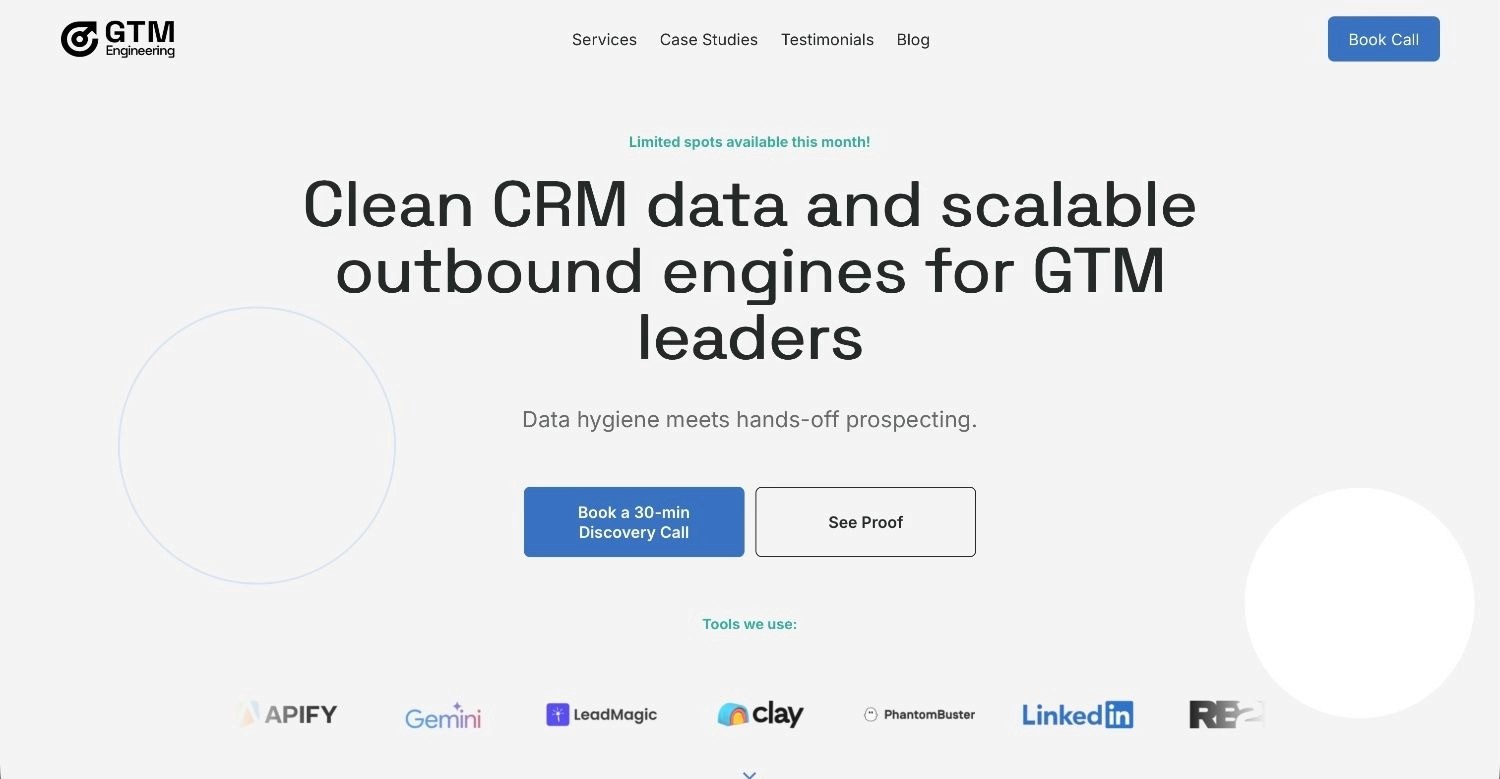
The GTM Engineering Company is a specialized go-to-market engineering and RevOps agency that builds clean CRM data foundations and scalable outbound engines for GTM leaders. Founded by Jorge Macías, a Y Combinator S18 alumnus and GTM sales automation expert, the firm focuses on custom GTM systems for VC-backed tech startups and small founding teams.
The company operates with a fractional GTM engineer model that blends RevOps strategy, data engineering, and outbound automation into engineered revenue pipelines. Unlike generic lead-gen shops, The GTM Engineering Company is tool-agnostic and builds workflows across Clay, email sequencers, and CRMs without vendor lock-in. Their systems rely on signal-based prospecting that layers firmographic, technographic, and trigger data to identify and prioritize high-intent accounts.
Clients report creating four opportunities in the first month and achieving ROI-positive engagements quickly. The firm has implemented over 100 GTM systems and advised 50+ B2B companies. Results include reducing research time from 2.5 hours to under 15 minutes per account, saving roughly 250 hours per rep per quarter. One enterprise client replaced 40% of their manual research workload through automated API workflows.
Type of Service: Fractional GTM Engineer / RevOps Consultancy
Best For: VC-backed B2B SaaS startups from Seed to Series B with product-market fit, high LTV products, and aggressive growth targets but limited in-house RevOps capacity.
Why It Stands Out: The GTM Engineering Company positions engagements as infrastructure builds rather than campaigns, designed to make revenue generation predictable and scalable. They emphasize knowledge transfer so systems remain in your stack, fully owned and documented even if the engagement ends. No technical skills required from your side.
Pros:
Automation-first execution. Scrapers, AI enrichment, and API connectors ship qualified pipeline in weeks instead of quarters
Tool-agnostic architecture. Builds workflows across Clay, email sequencers, and CRMs without vendor lock-in
Transparent pricing. Clear tiered structure starting at $4,000/month for Starter, $6,000/month for Growth
Full system ownership. Complete documentation and training means your team operates systems independently
Weekly hands-on sessions. Live iteration via Slack/Notion updates, not monthly PowerPoint reports
Y Combinator founder. Jorge Macías brings 0-3M ARR growth experience and technical sales automation expertise
2. RevPartners: HubSpot Elite Partner for Complex Revenue Operations
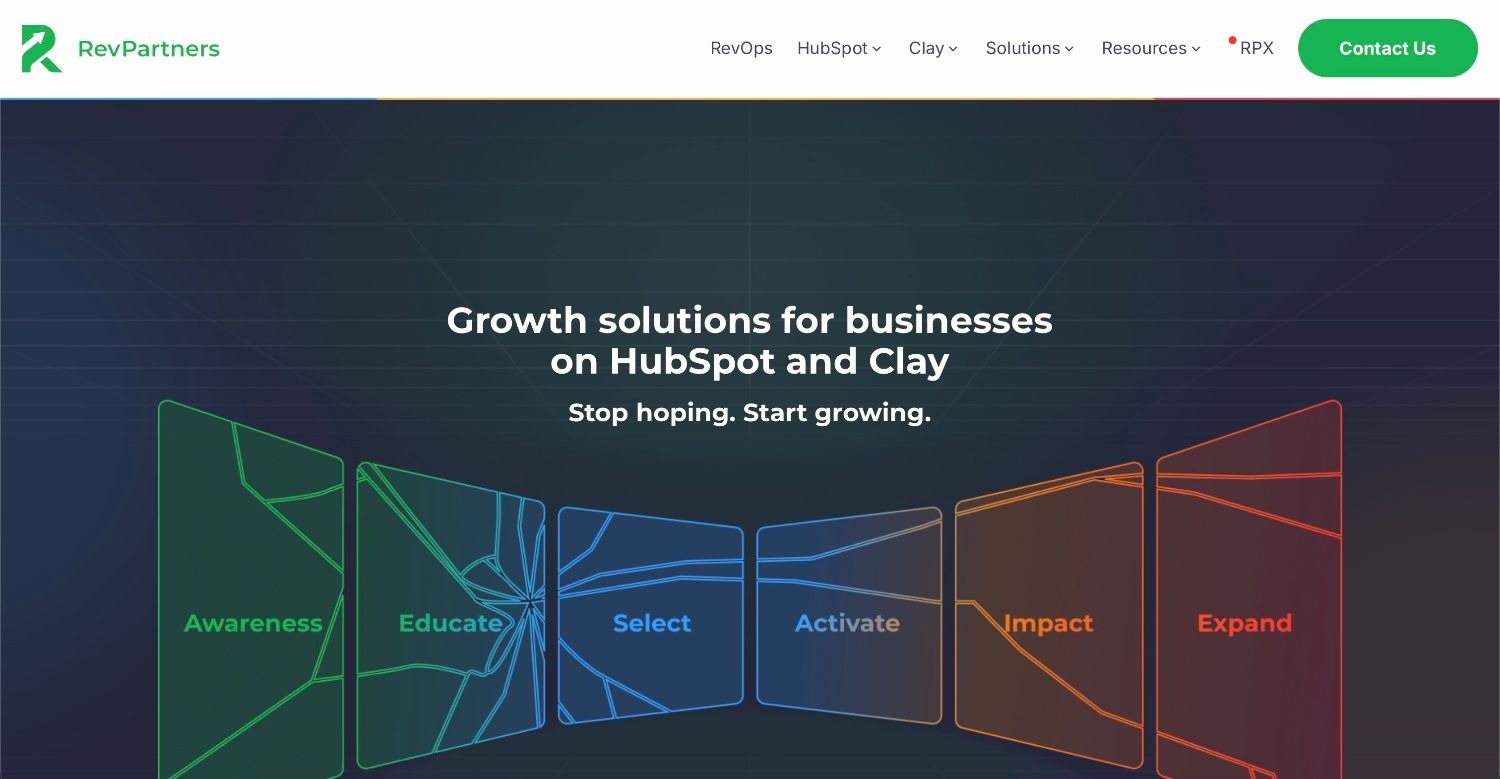
RevPartners operates as a HubSpot Elite partner specializing in revenue operations and automation. When it comes to revenue operations, they're among the best B2B revenue operations agencies and one of the largest HubSpot partners in the ecosystem.
Their core strength lies in complex HubSpot setups, advanced integrations, and automations that go beyond standard configurations. They build modern revenue engines with data-driven approaches and continuous improvement methodologies. The firm excels at architecting sophisticated workflows that connect marketing, sales, and customer success operations within the HubSpot ecosystem.
Type of Service: HubSpot Elite RevOps Agency
Best For: Mid-market to enterprise B2B companies with complex HubSpot environments requiring sophisticated automation and integrations.
Why It Stands Out: RevPartners combines strategic GTM engineering with Clay-powered automation as a HubSpot Elite RevOps and Clay enterprise partner. Their performance-focused approach emphasizes measurable revenue impact and system reliability at scale.
Pros:
Deep HubSpot expertise. Elite partner status with extensive experience in complex configurations
Revenue operations specialization. Focused specifically on RevOps, not general marketing services
Complex automation capabilities. Advanced integrations and workflows beyond standard implementations
Scale and resources. Large partner with capacity for enterprise-level projects
3. Aptitude8: Talent Hub Model for Complex Projects
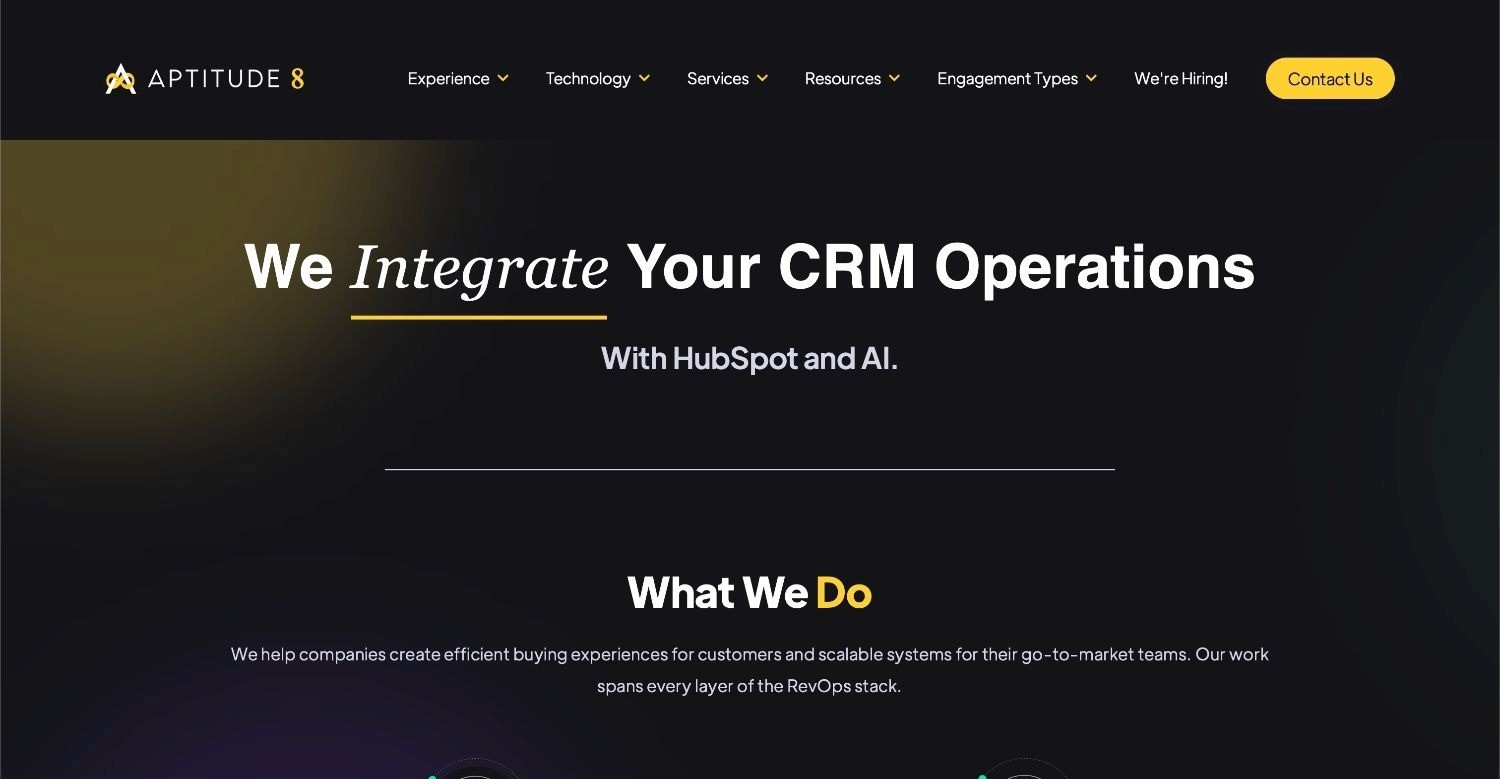
Aptitude8 brings a unique background to the B2B revops consultants space, combining deep HubSpot partnership with a talent hub model and product development heritage. I worked with them once on a project, and I can tell you they have a really good, really interesting talent hub approach.
They're one of the largest HubSpot partners and especially good for complex projects. While they obviously do revenue operations, they come more from an inbound marketing agency background. What makes them distinctive is their dedication to product development. Several products have come out from their ranks. The CEO even moved to Happily, which was a spin-off from the company.
This product development DNA means they approach RevOps problems with a builder mentality. They're comfortable with custom solutions and aren't afraid to architect new approaches when existing playbooks don't fit.
Type of Service: Full-Service HubSpot Partner
Best For: B2B companies with complex, multi-faceted projects requiring deep talent resources and custom solution development.
Why It Stands Out: Aptitude8's talent hub model provides access to specialized experts across RevOps, marketing, and product development. Their background in building and spinning off products signals a culture of innovation and systems thinking that goes beyond standard agency work.
Pros:
Talent hub access. Deep bench of specialized experts for complex requirements
Complex project expertise. One of the largest partners handling sophisticated implementations
Product development background. Builder mentality and custom solution capabilities
Innovation culture. Track record of spinning off successful products from internal teams
4. Sculpted: CRM Data Quality Specialists
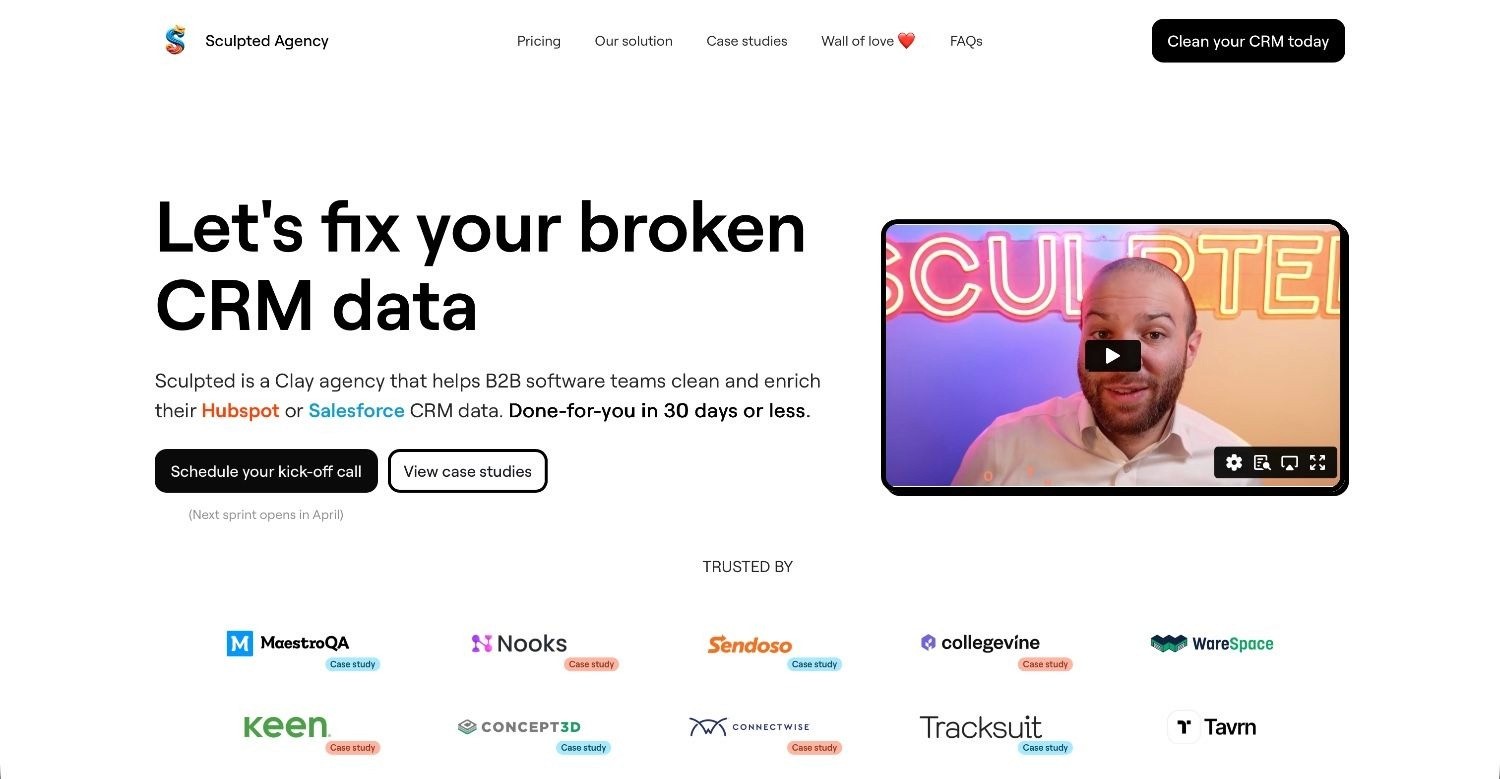
Sculpted is a CRM-focused agency primarily working in HubSpot and Salesforce CRM data quality and optimization. I'm really good friends with Jacob, the founder, and they've helped me with several data integrity projects.
They've worked with really cool companies like Nooks and Sendoso, focusing on the unglamorous but critical work of cleaning, structuring, and maintaining CRM data. While many agencies promise automation and growth, Sculpted specializes in the foundation that makes those promises possible: reliable, accurate, deduplicated data.
Type of Service: CRM Data Quality Agency
Best For: B2B companies whose CRM has become unreliable due to poor data quality, duplicate records, and inconsistent field usage.
Why It Stands Out: Sculpted focuses specifically on CRM data as the foundation of revenue operations rather than trying to be everything to everyone. Their client roster includes fast-growing SaaS companies that prioritize data hygiene as a competitive advantage.
Pros:
CRM data specialization. Deep focus on data quality, deduplication, and structure
Dual-platform expertise. Works across both HubSpot and Salesforce environments
Notable client roster. Proven track record with companies like Nooks and Sendoso
Foundation-first approach. Fixes the data layer before layering automation on top
5. Go Nimbly: Strategic RevOps with Thought Leadership
Go Nimbly is a well-established revenue operations agency that's been in the game for some time now. Jen, their founder, does some pretty cool content ranting about the state of RevOps or sales and marketing teams, which is really good for understanding current challenges.
They host an annual conference in May in New York that brings together RevOps practitioners and thought leaders. This community engagement signals their positioning as strategic advisors who understand the evolving landscape, not just execution shops.
Type of Service: Strategic RevOps Consultancy
Best For: Mid-market B2B teams that value strategic RevOps guidance combined with hands-on implementation support.
Why It Stands Out: Go Nimbly combines execution with thought leadership and community building. Their founder's content provides real insight into RevOps challenges, and their annual conference creates a network effect for clients.
Pros:
Strategic perspective. Strong thought leadership on RevOps strategy and team alignment
Established track record. Years in the market with proven methodologies
Community engagement. Annual conference and active content creation
Balanced approach. Blends consulting with implementation
6. RevPal: Fractional RevOps Leadership for Scaling B2B SaaS
RevPal is a RevOps-as-a-Service firm built for high-growth B2B SaaS teams that need senior-level revenue operations without the overhead of a full-time hire. They cover the full stack including CRM architecture, forecasting, attribution, and AI workflow automation, and lead every engagement with OpsPal, their proprietary diagnostic tool that scores your CRM health and delivers a prioritized roadmap before any build begins.
Their client roster includes funded SaaS companies like QuotaPath, Karat, Portless, and Lindy AI. Results include a Series B team hitting 94% forecast accuracy after a full pipeline rebuild, and a zero-downtime HubSpot-to-Salesforce migration for a 140-person MarTech company.
Type of Service: RevOps-as-a-Service / Fractional RevOps
Best For: Series A-C B2B SaaS teams that need embedded RevOps leadership, CRM rebuilds, or board-ready reporting infrastructure without adding headcount.
Why It Stands Out: RevPal diagnoses before it prescribes. OpsPal gives revenue leaders a scored picture of where systems are breaking before any solution is proposed – a refreshing contrast to agencies that jump straight to implementation.
Pros:
Diagnostic-first approach. OpsPal scores CRM health and surfaces gaps before work begins
Full RevOps stack. CRM implementation, AI agents, forecasting, and attribution in one engagement
Dual-platform expertise. Deep experience across both Salesforce and HubSpot, including complex migrations
Embedded team model. Works as an extension of your internal team, not a distant consultant
How to Choose the Right B2B Revenue Operations Agency
1. Assess Whether You Need New Systems or Optimization
The first decision point isn't which agency, but what type of work you actually need. Are you building from scratch or improving what exists?
If your sales team spends 20+ hours per week on manual RevOps tasks, your CRM is unreliable for forecasting, and you have disconnected point solutions, you need system builders. These are agencies like The GTM Engineering Company or Loop GTM that architect entirely new infrastructure. They're engineering-first, automation-focused, and designed for companies that have outgrown manual processes.
If you already have solid HubSpot or Salesforce infrastructure that needs tuning, optimization specialists make more sense. RevPartners or Sculpted can audit your existing setup, clean your data, and improve workflows without rebuilding everything. Ask yourself: would fixing our current systems solve the problem, or do we need a different foundation entirely?
2. Match Agency Specialization to Your Tech Stack
Platform expertise matters when you're deep in an ecosystem. Tool-agnostic approaches matter when you need flexibility.
If you've invested heavily in HubSpot and plan to stay there, RevPartners or Aptitude8's Elite partner status provides deeper platform knowledge than generalists. They know the edge cases, undocumented features, and integration workarounds that come from thousands of implementations.
If you're juggling multiple tools or want to avoid vendor lock-in, prioritize tool-agnostic firms. The GTM Engineering Company builds workflows across Clay, email sequencers, and any CRM without forcing you onto specific platforms. This matters if your stack evolves or if you're experimenting with new tools. Ask candidates: how much of your methodology is platform-specific vs transferable?
3. Evaluate Balance Between Strategy and Execution
Some agencies give you a roadmap. Others build the road. The best do both.
Look for firms that act as strategic thought partners while also building complex workflows and outbound systems. Testimonials should highlight both technical depth and sales acumen. Ask to see examples where they challenged your assumptions, not just executed your requirements.
Warning sign: agencies that only deliver reports, dashboards, or recommendations without hands-on implementation. These create knowledge without leverage. You want partners who architect, build, test, and iterate systems with you, then transfer ownership so you can maintain them. Ask: what will we own at the end of this engagement?
4. Understand Pricing Models and Time to Results
Agency pricing varies from $4,000/month retainers to $15,000+ for enterprise engagements. More important than the number is what you get and how fast.
Transparent agencies publish tiers. The GTM Engineering Company's $4,000 Starter and $6,000 Growth packages tell you exactly what's included. Others quote custom pricing after discovery, which can signal flexibility or obscure true costs. Compare the fully loaded cost of a junior SDR (roughly $80,000/year) against agency fees. A $6,000/month engagement that generates qualified pipeline within weeks may deliver faster ROI than a hire that takes months to ramp.
Ask about typical engagement length and when you'll see measurable results. The best firms show early wins (cleaned CRM data, first automated workflows) in weeks, then compound value over 3-6 month arcs. Be suspicious of long ramp periods or vague timelines. Your leverage question: how quickly will this generate pipeline or save my team time?
5. Test for Hands-On Collaboration vs Reporting Theater
The agency relationship model determines whether you get systems or slide decks. Weekly working sessions signal real partnership. Monthly status calls signal you're getting managed, not served.
Look for delivery patterns that include hands-on iteration, live collaboration tools like Slack or Notion, and shared ownership of outcomes. The GTM Engineering Company's weekly sessions and iterative builds contrast sharply with agencies that disappear for weeks then surface with reports.
Ask candidates: how many hours per week will we actually work together? Who on your team will I interact with? What happens between our scheduled calls? The best relationships feel like adding a senior technical resource to your team, not hiring a distant consultant. If the engagement feels transactional rather than collaborative, keep looking.
6. Verify Technical Capabilities Beyond Marketing Claims
Every agency claims automation expertise and data-driven approaches. Few can demonstrate complex technical execution.
Ask candidates to walk through their most challenging Clay table, their most complex API integration, or how they'd approach a specific problem you're facing. Strong technical agencies describe specific enrichment layers, API call sequences, normalization workflows, and edge-case handling. Weaker ones speak in generalities about "leveraging data" or "optimizing processes."
Request case studies with technical detail: What tools did you integrate? How did you handle data consolidation? What APIs did you connect? How did you automate verification? The gap between real technical depth and marketing fluff becomes obvious quickly. Trust the firms that can get specific.
The Core Benefits of Working with B2B Revenue Operations Agencies
1. Clean CRM Data and Account Intelligence
A clean, deduplicated, cheaper-to-maintain CRM gives sales clear account tiers and marketing real prioritization signals instead of guesses. Automated enrichment workflows fill missing firmographic and technographic data, pull traffic metrics and historical trends, and classify accounts automatically.
2. Increased Sales Effectiveness and Productivity
Sales gains a new lens into account health, allowing reps to reference growth, decline, or momentum directly in outreach and discovery calls. Automated pre-meeting briefs eliminate last-minute research, leading to sharper, more relevant inbound meetings better aligned to prospect needs. Companies report saving 250+ hours per rep per quarter on manual research.
3. Scalable Lead Qualification and Outreach
Revenue operations agencies build systems that target firms most likely to benefit from your solutions, validate outreach relevance by finding proof of pain, and scale repeatable automated lead qualification. This replaces manual prospecting with signal-based workflows that identify high-intent accounts automatically.
4. Predictable Pipeline Generation Without Adding Headcount
Automated systems generate qualified meetings without manual list building or cold calling. Companies report outbound conversion rates tripling and qualified meeting volume increasing while reducing manual prospecting by more than 80%. The infrastructure continues working beyond the engagement.
5. Enterprise-Grade GTM Infrastructure at Fractional Cost
The best agencies deliver enterprise-grade GTM infrastructure for roughly the cost of a single junior SDR. A $6,000/month engagement that ships pipeline in weeks provides faster ROI than an $80,000/year hire that takes months to reach productivity. Systems compound value over time while headcount scales linearly.
6. Knowledge Transfer and System Ownership
Top firms emphasize that clients own the systems after engagement, reducing perceived lock-in and making projects feel like capital expenditure on infrastructure rather than transient marketing campaigns. Complete documentation, training, and maintenance guides ensure your team can operate, troubleshoot, and adjust systems independently.
B2B Revenue Operations Agencies: Final Comparison
Agency | Pricing Model | Key Strengths | Best Use Case | Platform Focus |
The GTM Engineering Company | $4K-$6K/month tiered | Tool-agnostic builds, automation-first, system ownership | Building new revenue infrastructure from scratch | Cross-platform (Clay, HubSpot, Salesforce) |
RevPartners | Custom pricing | Complex HubSpot setups, revenue operations specialization | Sophisticated HubSpot automation and integrations | HubSpot Elite |
Aptitude8 | Custom pricing | Talent hub, complex projects, product development DNA | Multi-faceted projects requiring specialized experts | HubSpot |
Sculpted | Custom pricing | CRM data quality, dual-platform expertise | Fixing CRM data hygiene and structure | HubSpot & Salesforce |
Go Nimbly | Custom pricing | Strategic RevOps, thought leadership, community | Strategic guidance with execution support | Platform-agnostic |
Start Building Predictable Revenue with The GTM Engineering Company
Every week you delay fixing your revenue infrastructure costs you qualified meetings and wastes hours on manual research. Your sales team is drowning in CRM admin instead of selling. Your outbound campaigns generate noise instead of pipeline because your data is stale and your workflows are manual.
The GTM Engineering Company builds tool-agnostic revenue systems that generate qualified pipeline in weeks, not quarters. We architect Clay workflows, CRM integrations, and automated enrichment that your team owns completely. Engagements include weekly working sessions, transparent metrics, full documentation, and systems that continue working after we're done.
You'll get a fractional GTM engineer who combines RevOps strategy, data engineering, and outbound automation without vendor lock-in or dependency.
Talk to The GTM Engineering Company today and book a call here.
Frequently Asked Questions About B2B Revenue Operations Agencies
What exactly does a B2B revenue operations agency do?
A B2B revenue operations agency aligns your marketing, sales, and customer success departments by architecting the shared data and technology infrastructure they all rely on. These firms move beyond basic CRM administration to build automated lead routing, data enrichment pipelines, and attribution models that provide a single source of truth for your entire go-to-market team. By connecting disparate tools like HubSpot, Salesforce, and Clay, they eliminate manual data entry and ensure your revenue engine scales predictably without requiring massive headcount increases.
How much do B2B revenue operations agencies typically cost?
The cost of B2B revenue operations agencies varies based on the complexity of your tech stack, but most professional firms operate on monthly retainers ranging from $4,000 to $15,000. Specialized agencies like The GTM Engineering Company offer transparent tiered pricing starting at $4,000 per month, which is often more cost-effective than hiring a full-time senior RevOps manager. When evaluating costs, it is important to consider the ROI of reclaimed sales time and the increased pipeline velocity that high-quality systems provide compared to the expense of manual labor.
When is the right time to hire a RevOps agency instead of an in-house lead?
The right time to hire a RevOps agency is typically when your sales team is spending more than 20% of their time on manual admin tasks or when your CRM data has become too messy to support accurate forecasting. Agencies are particularly valuable during the Seed to Series B stages because they provide a "fractional" team of experts with specialized skills in data engineering and automation that a single hire likely won't possess. This approach allows you to build enterprise-grade infrastructure early on without the overhead and long ramp-up time associated with recruiting a full-time executive.
What is the difference between a HubSpot partner and a RevOps agency?
The difference between a HubSpot partner and a RevOps agency lies in the scope of their work; while a HubSpot partner focuses specifically on maximizing that one platform, a RevOps agency focuses on the entire revenue process across all tools. Many RevOps firms are indeed HubSpot partners, but they prioritize the strategic alignment of your data and the integration of your entire stack – including outbound tools and data providers – rather than just configuring marketing emails. You should choose a RevOps agency if you need a holistic system where your CRM, enrichment tools, and sales engagement platforms work together seamlessly.
How long does it take to see results from a RevOps engagement?
You should expect to see measurable results from a RevOps engagement within the first 30 to 60 days, starting with immediate improvements in data quality and automated workflows. Top-tier agencies focus on "early wins," such as automating account research or cleaning up lead routing, which provide instant relief to sales reps while the larger infrastructure is being built. By the end of a 90-day cycle, a successful engagement should result in a fully documented system that generates more qualified meetings and provides clear visibility into your funnel performance.
Will I be locked into a specific tool if I work with an agency?
You will not be locked into a specific tool if you work with a tool-agnostic agency that prioritizes system ownership and flexible architecture over platform-specific badges. The best B2B revenue operations agencies build workflows using API connectors and middleware that can be adapted if you decide to switch from HubSpot to Salesforce or change your data providers. It is crucial to ask potential partners about their documentation process to ensure your internal team can manage and modify the systems long after the agency engagement has concluded.
How do RevOps agencies help with outbound sales automation?
RevOps agencies help with outbound sales automation by building "GTM engines" that use signal-based prospecting and AI-driven enrichment to identify high-intent accounts automatically. Instead of having SDRs manually scrape LinkedIn or guess at email addresses, the agency architects a pipeline that pulls data from sources like Clay or Cognism and pushes it directly into your sequencer. This technical approach ensures that your outreach is highly personalized and timed to specific triggers, which significantly increases reply rates while reducing the manual workload for your sales team.