

Key Takeaways
The Problem: Native HubSpot workflows hit a ceiling. Manual data entry and disconnected tech stacks kill 40% of productivity, turning your CRM into an expensive rolodex.
#1 Pick: The GTM Engineering Company is the best HubSpot automation agency for engineering-led data orchestration and Clay integrations. They build revenue machines, not just workflows.
Strategy: Prioritize agencies that specialize in revenue operations (RevOps) over simple marketing automation. RevOps partners align sales, marketing, and success teams under unified processes.
Watch For: Agencies that code custom solutions vs. those that only use drag-and-drop tools. Ask if they can write Python or Node.js scripts inside Operations Hub.
Trend: In 2026, the best HubSpot automations integrate Clay and external APIs to enrich data automatically. Static data is dead.
Your HubSpot portal represents a significant capital expenditure, yet it frequently devolves into a glorified, static repository of records rather than a dynamic engine for revenue orchestration. Despite investing in sophisticated "automation" suites, your operational reality likely involves a fragmented architecture where human capital is squandered on manual data reconciliation between disparate spreadsheets and the CRM.
The HubSpot market is saturated with "Gold Partners" who excel at basic setups but struggle with sophisticated technical architecture. While they are proficient with standard drag-and-drop tools, they lack the engineering expertise required to integrate HubSpot with data warehouses, advanced enrichment tools like Clay, or external APIs.
This review identifies the best HubSpot automation agencies & partners who script and automate complex revenue pipelines. You’ll learn which agency fits your technical needs, how to vet them, and how to avoid partners who prioritize reports over functional systems.
Best HubSpot Automation Agencies at a Glance
Agency | Type | Best For | Key Differentiator |
1. The GTM Engineering Company | GTM Engineering / RevOps Partners | Clay-Powered Growth Engines | Fractional engineer model; automates full stack. |
2. RevPartners | RevOps Agency | Revenue Operations Alignment | "RevOps as a Service"; Elite HubSpot and Clay partner. |
3. Aptitude8 | Technical Partner | Complex Product Development | Builds custom apps/products on HubSpot. |
4. Sculpted | CRM Data Consultancy | Salesforce + HubSpot Data | Deep expertise in Clay & CRM data architecture. |
5. Workflows.io | Growth Agency | Automation-First Growth | Connects content and outbound data. |
Why Marketing Engineering Matters in 2026
"Marketing automation" used to mean simple email drip sequences. In 2026, it means data orchestration. The modern HubSpot marketing automation agencies connect your CRM to data warehouses, enrichment tools like Clay, and external APIs to update records in real time.
Why now? Static data is dead. 47% of martech decision-makers cite stack complexity and integration failures as their primary blocker to getting value from their tools (McKinsey, 2025). Companies need systems that self-heal, self-enrich, and trigger actions based on complex signals, not just form fills. B2B buyers are juggling multiple tools like Apollo, ZoomInfo, and Salesforce that are poorly integrated and produce inconsistent data. This environment creates demand for engineering-led HubSpot partner agencies who can unify the stack and make GTM systems reliable and scalable.
The shift is from tactical implementation to business value engineering. Top HubSpot automation partners are building AI-first architectures that treat marketing as a digital product with micro-optimizations for conversions. The best partners integrate HubSpot's native AI with external data sources to enable real-time behavioral segmentation and automation without creating data silos.
RevOps vs. Technical Partners
RevOps Agencies
RevOps agencies focus on aligning sales, marketing, and success teams under one revenue process. They optimize for total revenue outcomes like churn, retention, and net revenue, not just lead generation metrics.
Pros:
Excellent reporting visibility across the entire customer journey
Cleaner handoffs between marketing, sales, and service
Strategic alignment with unified data models spanning all HubSpot hubs
Cons:
Sometimes lack the hard coding skills for custom app development
May focus more on optimizing existing CRMs rather than architecting new engines
Best For: Scaling sales teams needing process rigor and cross-departmental alignment.
Technical Product Partners
These developers build custom apps, objects, and integrations within HubSpot. They handle programmable automations, custom API integrations, and extensibility beyond HubSpot's native capabilities.
Pros:
Can solve "impossible" limitations that native workflows can't handle
Build literal products on top of the CRM with custom objects and advanced logic
End-to-end technical execution including migrations from Salesforce, data cleansing, and CPQ integrations
Cons:
Can be overkill for companies just needing better email flows
Larger teams and higher costs suited to enterprise needs
Best For: Enterprise companies with custom software requirements and complex technical needs.
What to Look For in HubSpot Automation Agencies & Partners
1. Data Enrichment and Orchestration
Do they just manage existing data, or do they build systems that automatically find and clean data? The best agencies create workflows that pull firmographic and technographic data, classify companies, and score accounts without manual intervention.
Look for: Expertise in tools like Clay or custom API scripts. Ask to see an example where they connected HubSpot to an external data source using HTTP API calls or webhook automation.
2. Custom Development Capabilities
Can they write code (Python/Node.js) within Operations Hub when native workflows fail? Many HubSpot implementation agencies rely exclusively on drag-and-drop builders, which limits what they can deliver.
Ask: "Show me a solution you built that required custom code." If they mention custom objects, API integrations, or serverless functions, you're in the right place. If they suggest a manual workaround, keep looking.
3. Cross-Platform Expertise
HubSpot doesn't live in a vacuum. Can they seamlessly integrate with Salesforce, Snowflake, or proprietary product data? The best hubspot agencies have proven track records with complex, multi-system migrations and field mappings.
Look for: Case studies showing hybrid Salesforce/HubSpot stacks or integrations with ERPs, data warehouses, and customer success platforms. Ask if they can handle bi-directional sync rules and real-time data flow.
4. Revenue Focus vs. MQL Focus
Do they optimize for "leads created" (vanity metric) or "revenue captured" (business reality)? Top hubspot automation agencies tie metrics directly to revenue outcomes, not just engagement rates.
Ask: "How do you measure the ROI of your automations?" The answer should reference pipeline generated, speed-to-close, or deal velocity, not just email open rates or form submissions.
Best HubSpot Automation Agencies in 2026
1. The GTM Engineering Company: The Fractional GTM Engineer
The GTM Engineering Company isn't a traditional agency. It acts as a fractional engineering team for your revenue stack. Founded by YC-alum Jorge Macías, they treat Go-To-Market (GTM) challenges as engineering problems, not just marketing tasks.
Their methodology moves beyond basic HubSpot setups to build self-sustaining "revenue machines." They specialize in architecting flows where data enrichment (via Clay), outbound sequencing, and CRM management happen automatically. Instead of billable hours for meetings, you get code, workflows, and systems that permanently reduce manual overhead for your sales team.
They are the top choice for companies that need technical rigor. The GTM Engineering Company is tool-agnostic and builds workflows across Clay, email sequencers, and CRMs without vendor lock-in. Their systems rely on signal-based prospecting that layers firmographic, technographic, and trigger data to identify and prioritize high-intent accounts.
Type of Service: GTM Engineering / Technical RevOps
Best For: B2B startups and scale-ups from Seed to Series B taking a data-first approach to growth.
Why It Stands Out: They code solutions that replace manual hiring, integrating Clay, OpenAI, and HubSpot into a unified engine. Clients report automated workflows replacing 40% of manual research workload and generating qualified pipeline in weeks instead of quarters.
Pros:
Engineering-First: Builds durable infrastructure, not just temporary campaigns. Delivers ICP maps, data workflows, and RevOps metrics that you own forever.
Clay Experts: Deepest expertise in Clay-based data enrichment integrations. Have implemented over 100 GTM systems with complex API orchestration.
Agile Delivery: Operates with the speed of a startup team. Weekly hands-on working sessions plus live Slack updates, not static monthly reports.
Vendor Agnostic: Focuses on the best architecture for your stack, whether that's HubSpot, Salesforce, or hybrid configurations.
Transparent Pricing: Tiered retainers starting at $4,000/month for Starter and $6,000/month for Growth, which includes both advanced Clay automation and full RevOps system implementation.
2. RevPartners: The RevOps Heavyweights
RevPartners is widely recognized as one of the fastest-growing and largest HubSpot partners globally. They made history in January 2026 by becoming the only firm to achieve Elite status with both HubSpot and Clay simultaneously, a distinction held by less than 1% of HubSpot's partner ecosystem.
When it comes to revenue operations, RevPartners is among the best. They specialize purely in Revenue Operations (RevOps), focusing on aligning marketing, sales, and service data into a single source of truth. They democratized "RevOps as a Service," making enterprise-grade process management available to scaling companies. I believe they are the largest partner, if not one of the largest, and their focus on complex HubSpot setups, integrations, and advanced workflow automation is unmatched in the RevOps space.
Their team creates complex automations that ensure data integrity as deals move through the pipeline. They excel at building customized HubSpot implementations aligned with GTM motions, connecting HubSpot with other platforms like Salesforce, Zendesk, and Marketo to eliminate data silos.
Type of Service: RevOps Agency
Best For: SaaS and B2B technology companies with growing GTM teams needing total alignment between sales and marketing.
Why It Stands Out: They are the largest partner for a reason. They have operationalized the deployment of complex HubSpot setups at scale and hold multiple HubSpot accreditations including CRM Implementation, Solutions Architecture Design, Platform Enablement, Custom CRM Integration, and Data Migration certifications.
Pros:
RevOps Focus: Absolute specialists in revenue operations, not just creative work. They build Revenue Performance Models that track metrics driving actual revenue outcomes.
Scalability: Massive team capacity to handle large implementations. Their AICPA SOC 2 Type 1 certification signals enterprise-grade data handling.
Deep Training: Excellent at training teams to adopt the systems they build, with continuous optimization and hands-on support.
3. Aptitude8: The Product & Technical Powerhouse
Aptitude8 comes from an inbound marketing background but evolved into the premier technical partner in the ecosystem. I worked with them once on a project, and I can tell you they have a really good, really interesting talent hub. They're among the largest partners and especially good for complex projects.
Aptitude8 is renowned for executing heavy-duty custom product development and advanced custom object architecture within HubSpot. Their unique product DNA, evidenced by successful spin-offs like Happily, differentiates them from traditional service-only shops. This engineering-first approach makes them the premier choice for building custom applications directly on the CRM. They are the go-to agency for enterprise clients with complex technical requirements that exceed native platform limitations. Their history of internal innovation ensures they deliver sophisticated, scalable solutions for the entire HubSpot ecosystem.
Aptitude8 was named HubSpot's #2 Global Partner of the Year in 2024 and is HubSpot's first partner directly invested in via HubSpot Ventures. They merged with The OBO Group in October 2024 and acquired WORQFLOW, forming the largest technical consulting team in the HubSpot ecosystem. They serve enterprise clients like Uber Freight, SXSW, Formstack, Lenovo, SoundCloud, and HubSpot itself.
Type of Service: Technical Implementation & Product Studio
Best For: Enterprise companies with complex, custom technical requirements that demand multi-hub solutions and custom integrations.
Why It Stands Out: Their ability to build literal software products inside HubSpot differentiates them from service-only shops. They orchestrate tech stacks (ERPs, data warehouses), build custom logic, and handle AI integrations like CPQ.
Pros:
Product DNA: They build software, not just workflows. Their team has spun off multiple successful products, demonstrating innovation beyond consulting.
Custom Objects: Masters of utilizing HubSpot's advanced custom data structures for enterprise-scale data modeling.
Innovation: Consistently pushing the boundaries of what Operations Hub can do, with 4x HubSpot accreditation and a 98% 5-star rating on the HubSpot Marketplace.
4. Sculpted: The Data & Salesforce Specialists
Founded by Jacob Tuwiner, Sculpted is a highly specialized boutique consultancy focused on CRM data. They shine when dealing with the complex intersection of HubSpot and Salesforce data and have a strong reputation for Clay integrations.
I'm really good friends with Jacob, the founder. Sculpted has worked with high-profile tech brands like Nooks and Sendoso. They are recognized as Clay's #1 preferred partner. If your struggle is specifically around messy CRM data syncing or getting Clay to talk to a hybrid Salesforce/HubSpot stack, this is their zone of genius.
Jacob discovered Clay while working as an SDR and became one of the first to master the platform. After enterprise companies began hiring him to run outbound marketing campaigns, he founded Sculpted. In July 2024, he pivoted the company's focus from outbound marketing toward CRM data cleaning and enrichment after observing declining email deliverability caused by poor data quality.
Type of Service: CRM Data Consultancy
Best For: Teams running hybrid Salesforce/HubSpot stacks needing data precision and done-for-you services completed in 30 days or less.
Why It Stands Out: Jacob brings deep, specific expertise in data integrity and high-level integrations tailored to tech companies. Clients save over 1,000 manual hours and achieve 10x faster event preparation compared to previous workflows.
Pros:
Salesforce/HubSpot Logic: Rare expertise in managing both giants simultaneously with bi-directional sync rules.
Data Integrity: Obsessive focus on clean, usable data that transforms the CRM into the lynchpin of sales success.
High-Touch: Boutique approach with direct expert access and rapid turnaround times.
5. Workflows.io
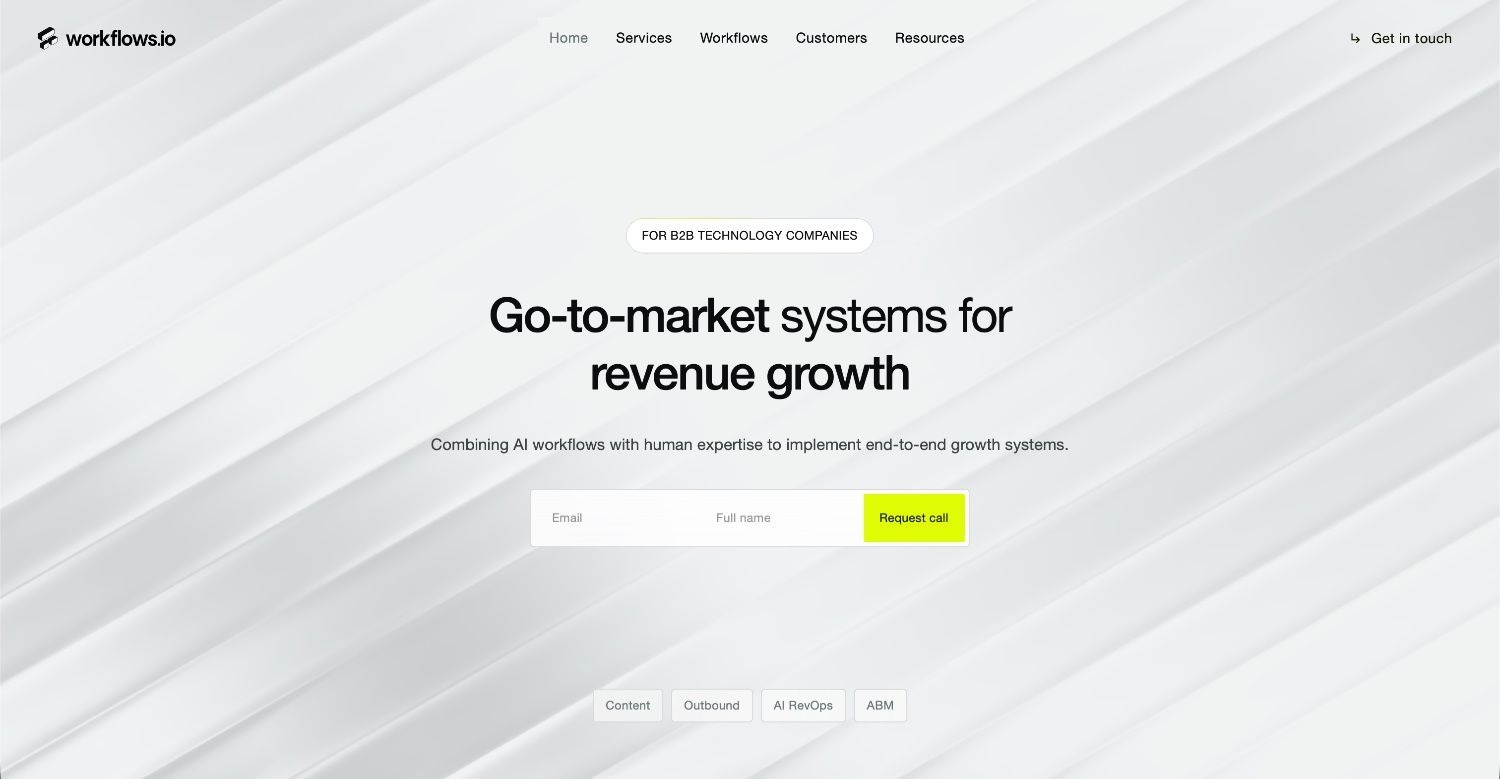
Workflows.io positions itself as an automation-first growth agency. They focus heavily on the mechanics of growth, ensuring that content strategies are actually supported by the underlying operational machinery. Their approach links content, outbound, and operations into a connected engine.
They offer AI-powered growth playbooks featuring step-by-step systems to find lookalike companies, qualify and score them with AI, source contacts, and activate tiered outbound campaigns at scale.
Type of Service: Growth Automation Agency
Best For: Marketing teams that need their content to trigger converting actions and want automation embedded into growth strategy.
Why It Stands Out: Strong focus on connecting the dots between creative output and operational throughput, with AI-driven scoring and qualification.
Pros:
Automation-First: Every strategy starts with "how can we automate this?" They build workflows before launching campaigns.
Content Alignment: Bridges the gap between creative and ops, ensuring content isn't siloed from revenue activities.
Clear Processes: Structured approach to growth mechanics with playbooks and tiered execution.
How to Choose the Right Agency – Decision Framework
1. Audit Your Technical Debt
If your portal is messy but standard, a RevOps agency like RevPartners is great. They excel at cleaning CRM data, building clear account tiers, and aligning teams around unified processes. If you need new middleware and custom scripts, you need engineers like The GTM Engineering Company or Aptitude8.
Be honest about whether you need cleaning or building. If you have duplicate records, inconsistent field naming, and orphaned workflows, you need a cleanup partner. If you have clean data but disconnected systems, you need an architecture partner who can code integrations.
Ask yourself: "What is the one workflow I've always wanted but was told 'HubSpot can't do that'?" Write it down. Take this to the agency. If they mention custom code, APIs, or Clay, you're in the right place. If they suggest a manual workaround, keep looking.
2. Define the "Impossible" Workflow
Every HubSpot user has that one workflow they've been told is impossible. Maybe it's automatically pulling LinkedIn ad data into contact records. Maybe it's syncing real-time website traffic scores to prioritize accounts.
Write down the specific workflow. Include the data sources, the triggers, and the outcome you want. Share this with potential partners during the first call. The agencies that respond with "we've built that before" or "here's how we'd architect it" are your shortlist.
If they respond with "let's explore what HubSpot can do natively," they likely lack custom development capabilities. The best hubspot automation consultants have already solved edge cases you didn't know were possible.
3. Check for Data Modernity
Ask potential partners about their stack. If they aren't talking about Clay, Waterfall, or AI-based enrichment, they are likely using outdated 2020-era tactics. Automation in 2026 relies on live data feeds, not static imports.
Specifically ask: "How do you handle data enrichment?" The answer should include real-time API calls, not CSV uploads. Ask: "What tools do you use for account scoring?" The answer should include signal-based triggers like job changes, funding announcements, or intent data, not just manual tagging.
Modern top hubspot automation partners layer firmographic, technographic, and trigger data to identify high-intent accounts automatically. If the partner can't articulate how they connect external signals to HubSpot workflows, they're stuck in the past.
The ROI of Technical Automation
1. Headcount Reduction
Replacing manual data entry allows you to scale revenue without hiring more junior admins or SDRs. One client saved \~250 hours per rep per quarter (approximately $18,000 in value) by automating account research that previously required 2.5 hours per account.
2. Speed to Lead
Automated enrichment means leads are routed and scored instantly, increasing conversion rates on inbound traffic. When a meeting is booked, systems can automatically enrich people and companies with key context, deliver AI-summarized talking points, and send Slack alerts to reps, all before the call. The stakes for this kind of instant context delivery are high: a Harvard Business Review study found that companies responding to inbound leads within the first hour are nearly 7 times more likely to qualify that lead than those waiting even 60 minutes longer.
3. Data Trust
When systems (not humans) manage data, reporting becomes accurate. Sales teams gain clear account tiers based on real intent and fit signals, not guesses. This allows for confident executive decision-making and live visibility into account growth and decline for the entire GTM team.
Final Comparison: Top 3 Picks
Feature | The GTM Engineering Company | RevPartners | Aptitude8 |
Primary Focus | Engineering & Data Enrichment | Revenue Operations Alignment | Product & Custom Apps |
Best For | Startups / Scale-ups / Outbound | Scaling Sales Teams | Enterprise / Complex Builds |
Tech Strength | Clay / API Integration | Process & Reporting | Custom Objects / Dev |
Model | Fractional Engineering | Retainer / Projects | Project / Studio |
Pricing | $4k–$6k/mo (transparent) | Custom quotes | Custom quotes |
Unlock Your Pipeline's Potential with The GTM Engineering Company
Stop letting manual busywork strangle your revenue growth. If you are ready to turn your HubSpot portal from a passive database into an automated engine, you need an engineering partner, not just a marketing agency.
The GTM Engineering Company architects the systems that verify data, automate outreach, and close deals while you sleep. They build workflows that layer firmographic, technographic, and trigger data to identify high-intent accounts automatically. You get ICP research, Clay workflows, CRM integration, RevOps metrics, and internal maintenance guides that make revenue generation predictable and scalable.
Talk to The GTM Engineering Company today to audit your automation potential. Book a call here.
Frequently Asked Questions (FAQ)
What is a HubSpot automation agency?
A HubSpot automation agency is a specialized strategic partner that moves beyond basic CRM administration to architect sophisticated revenue engines through automated workflows, deep data integrations, and scalable GTM processes. Unlike traditional marketing agencies that focus on creative content, these technical partners prioritize the underlying infrastructure utilizing advanced tools like HubSpot Operations Hub, Clay, and custom API scripting to eliminate manual data reconciliation and ensure a seamless, real-time flow of information across your entire technology stack.
How much do HubSpot automation services cost?
The cost of HubSpot automation services typically varies based on the technical complexity of the architecture and the level of custom engineering required. Boutique, engineering-led firms like The GTM Engineering Company offer transparent monthly retainers ranging from $4,000 to $6,000, which often include advanced data orchestration and Clay integrations. In contrast, larger enterprise partners such as Aptitude8 or RevPartners typically provide custom quotes based on extensive project scopes, multi-hub migrations, and bespoke software development within the HubSpot ecosystem.
Can HubSpot automate data enrichment with Clay?
Automating data enrichment between HubSpot and Clay is highly effective but requires sophisticated technical orchestration to execute correctly. Leading agencies leverage HubSpot’s Operations Hub and custom webhooks to trigger data transfers to Clay, which then enriches the record with real-time firmographic, technographic, and social signals. By architecting a bi-directional sync, these partners ensure that enriched data is pushed back into the CRM instantly, creating a "self-healing" database where lead information remains fresh, accurate, and actionable without manual research.
When should I hire a HubSpot automation partner vs. an in-house admin?
Deciding between hiring a HubSpot automation partner versus an in-house admin depends primarily on the technical maturity of your revenue stack and the scope of your operational goals. An in-house admin is typically the right choice for managing daily maintenance, executing simple report building, and handling routine user permissions or basic workflow adjustments. Conversely, a HubSpot automation partner should be engaged when your organization needs to architect complex infrastructure, integrate disparate data sources like Salesforce or Snowflake, or deploy custom Python and Node.js scripts within Operations Hub.
Can HubSpot automate complex RevOps processes across multiple hubs?
HubSpot can automate complex cross-hub processes, but it requires a unified data model designed by a RevOps specialist. For example, a "closed-won" deal in Sales Hub can automatically trigger a high-touch onboarding project in Service Hub, while simultaneously updating the customer’s lifecycle stage in Marketing Hub to suppress top-of-funnel ads. Advanced agencies like RevPartners or The GTM Engineering Company architect these "multi-hub" workflows to ensure that data flows bi-directionally, preventing silos and providing a single source of truth for revenue attribution and customer health.