

Key Takeaways (TL;DR)
The Problem: Most teams hit a "DIY ceiling" where Clay tables become brittle, manual prospecting persists, and data workflows break under scale. Moving beyond basic enrichment requires shifting from simple table-building to professional GTM engineering.
Top Pick: Jorge Macias (The GTM Engineering Company) is the premier choice for high-growth B2B SaaS. As a YC-backed firm with 100+ implementations, they deliver fractional GTM engineering that integrates Clay into your full revenue stack rather than leaving it as an isolated data silo.
Systems Over Tutorials: Prioritize experts who ship production-ready systems over those who only create content. The most valuable practitioners, like Jordan Crawford and Adam Andrewjesky, provide technical breakdowns of real-world workflows that solve complex pipeline challenges.
Fractional Leverage: Choose fractional experts over traditional agencies to avoid templated "junior-staff" builds. Fractional specialists deliver hands-on weekly execution and full knowledge transfer, often cutting time-to-pipeline by 60% or more.
Architectural Thinking: Look for multi-tool orchestration rather than single-platform mastery. Top experts like Tim Yakubson and Michael Sarugia focus on how Clay connects to CRMs, AI enrichment APIs, and sequencers to create a unified command center.
The Education-Execution Balance: The best clay power users, such as Eliot Nordstrom, maintain a balance between sharing tactical insights and running an active consulting practice. This ensures their advice is grounded in current, scalable implementation patterns.
Best Clay Experts: At a Glance
Name / Company | Type | Best For | Key Differentiator |
Jorge Macias (The GTM Engineering Company) | Fractional GTM Engineer | VC-backed B2B SaaS startups needing full GTM infrastructure | Y Combinator founder with 100+ GTM systems built; tool-agnostic Clay + RevOps architecture |
Jordan Crawford | Content Creator / Consultant | Learning advanced Clay workflows and signal-based prospecting | Prolific educator who shares production-ready systems and technical breakdowns |
Adam Andrewjesky | Clay Practitioner / Educator | Understanding Clay best practices and workflow optimization | Combines hands-on building with clear teaching style; active in Clay communities |
Tim Yakubson | Educator / Consultant | Clay education and implementation support | Consistent content output on Clay tactics with practical implementation focus |
Eliot Nordstrom | Consultant / Educator | Balanced learning and hiring for tactical Clay projects | Shares tactical insights while maintaining active consulting engagements |
Michael Sarugia | Clay Specialist | Technical Clay implementations and API integrations | Strong technical depth in complex Clay builds and automation |
What Are Clay Experts?
Clay experts are GTM specialists who master the Clay.com platform to build automated data enrichment, research, and prospecting systems. They combine technical skills in API integration, workflow design, and data normalization with strategic thinking about ICP definition, signal detection, and revenue architecture. The best clay practitioners don't just build tables; they architect systems that connect Clay to CRMs, email sequencers, and intent data sources to create scalable, predictable pipeline.
In 2026, the definition of a clay expert has evolved beyond basic table building. Early Clay users focused on simple enrichment: take a list of companies, add firmographic data, export to CSV. Today's top clay users build multi-stage workflows that layer technographic signals, trigger events, and AI-powered research into unified systems that replace entire prospecting teams. They understand waterfall enrichment strategies, cost optimization across data providers, and how to maintain data quality at scale.
What modern Clay experts handle:
Multi-provider data enrichment workflows with fallback logic
API integrations connecting industry-specific databases to Clay tables
Signal-based prospecting using website visitors, job changes, funding events, and tech stack shifts
CRM bidirectional sync architecture for HubSpot, Salesforce, and other platforms
AI-powered research automation using GPT prompts and custom scrapers
Deliverability and compliance frameworks for automated outbound campaigns
Performance dashboards and ROI tracking for GTM systems
The shift in 2026 is that Clay has become infrastructure, not a tool. Companies no longer ask "Should we use Clay?" They ask "Who can build our Clay systems so they scale without breaking?" Gartner predicts that 65% of B2B sales organizations will transition from intuition-based to data-driven decision making by 2026, merging sales process, data, and analytics into unified operational systems; the exact infrastructure Clay automation agencies are built to deliver. Meanwhile, McKinsey estimates that generative AI and automation tools could unlock $0.8 trillion to $1.2 trillion in incremental productivity across sales and marketing functions.This creates two distinct categories: experts to follow for education and experts to hire for implementation.
The Core Benefits of Working with Clay Experts
Benefit | Description |
Accelerated Time to Pipeline | Hiring the best clay experts collapses the learning curve from months to weeks. Instead of trial-and-error table building, you get production-ready workflows that ship qualified pipeline immediately. |
Cost-Effective Scaling Without Headcount | A fractional Clay consultant or GTM engineer delivers enterprise-grade infrastructure for roughly the cost of a junior SDR ($4,000 to $6,000/month), but with far greater leverage. Automated Clay systems can replace 40% or more of manual research workload, letting your existing team focus on closing rather than prospecting. |
Reduced Tool Sprawl and Tech Stack Complexity | Top clay users know how to consolidate fragmented point solutions into unified workflows. Instead of juggling Apollo, ZoomInfo, LinkedIn Sales Navigator, and three different email tools, you get orchestrated systems where Clay acts as the command center. This reduces subscription costs and eliminates data inconsistency. |
Knowledge Transfer and System Ownership | The best clay practitioners emphasize teaching, not dependency. Engagements include documentation, training, and SOPs that make you self-sufficient. Unlike agencies that lock you into ongoing retainers, fractional Clay specialists build systems you own and operate independently after the project ends. |
Faster GTM Iteration and Testing | With automated enrichment and research workflows, your team can test new ICPs, messaging angles, and channel strategies in days instead of quarters. Clay experts build modular systems that let you experiment without rebuilding infrastructure from scratch each time. |
Proof of Expertise Through Measurable Outcomes | Working with proven Clay GTM experts means access to best practices, lessons from 100+ implementations, and patterns that work across industries. You avoid expensive mistakes like over-enriching data, choosing the wrong providers, or building workflows that break under scale. |
Clay Consultants vs Content Creators
Clay Consultants and Freelancers
Clay consultants are hired to build, implement, and maintain custom workflows for revenue teams. They work hands-on inside your Clay workspace, connecting data sources, designing enrichment logic, and training your team to operate systems independently.
Pros:
Hands-on implementation that ships pipeline in weeks, not months
Custom builds tailored to your ICP, data stack, and CRM architecture
Knowledge transfer through documentation, training, and weekly working sessions
Full-stack thinking that connects Clay to your broader GTM infrastructure
Cons:
Higher upfront cost compared to DIY learning
Require clear ICP and data strategy to maximize ROI
Best for: B2B SaaS teams with aggressive growth targets, complex data needs, or existing Clay tables that need professional refactoring and scaling.
Content Creators and Educators
Clay content creators publish tutorials, breakdowns, and templates on LinkedIn, YouTube, and community forums. They help you learn Clay tactics, understand new features, and see what's possible without directly building your systems.
Pros:
Free or low-cost learning resources accessible to anyone
Inspiration for new workflows and use cases you haven't considered
Community access through their networks and follower bases
Rapid updates on new Clay features and data provider integrations
Cons:
Generic examples that require translation to your specific use case
No hands-on support when your implementation breaks or underperforms
Best for: Founders and RevOps leads who want to build Clay literacy before hiring, or teams with in-house technical talent who can adapt public workflows.
The ideal model combines both: follow the best clay power users for education, then hire a clay expert when you're ready to scale systems beyond what tutorials can support.
What to Look For in a Clay Expert
1. Multi-Tool Orchestration, Not Single-Platform Mastery
Real Clay expertise isn't about knowing every feature. It's about connecting Clay to the rest of your GTM stack. Look for specialists who demonstrate experience integrating Clay with CRMs, email platforms, scrapers, and intent data sources in cohesive workflows.
Ask yourself: Can this expert show examples of Clay feeding clean, enriched data into Salesforce or HubSpot, triggering automated sequences in Lemlist or Instantly, and syncing back engagement data for scoring?
2. Production Systems, Not Just Tutorial Content
The best clay consultants share real systems they've built for clients, complete with results and technical breakdowns. Beware of experts whose only proof is screenshot threads without measurable outcomes.
Look for: Case studies showing conversion rates, time saved, pipeline generated, or cost reductions from Clay implementations. Public workflow libraries or GitHub repos signal deeper technical credibility than polished LinkedIn carousels.
3. Signal-Based Prospecting and Intent Data Fluency
Top Clay GTM experts don't build static lists. They architect dynamic systems that layer firmographic, technographic, and trigger data to prioritize accounts with the highest intent. This requires understanding data providers, webhooks, and conditional logic.
Ask yourself: Does this expert talk about waterfall enrichment, intent signals, job change tracking, or tech stack monitoring? Or do they only teach basic company and contact lookups?
4. Teaching Ability and Knowledge Transfer
Whether you're following for education or hiring for implementation, strong Clay specialists explain their thinking. They document workflows, record walkthroughs, and train your team to operate systems independently after the engagement.
Look for: Loom videos, public Notion docs, or SOPs that accompany their builds. Testimonials mentioning "Jorge trained our team" or "We can now maintain this ourselves" indicate real knowledge transfer.
5. Tool-Agnostic Architecture and Vendor Neutrality
The best clay practitioners don't lock you into specific data providers or platforms. They design systems that work across Apollo, ZoomInfo, Cognism, and niche databases, with fallback logic when primary sources fail.
Ask yourself: Does this expert emphasize flexible architecture, or do they push a single vendor stack? Specialists who highlight cost optimization and provider flexibility deliver more durable systems.
6. Track Record with Companies Like Yours
Clay workflows for enterprise sales look different from workflows for PLG startups. Experts who've built systems in your industry or revenue range understand your data challenges, compliance needs, and buying committee complexity.
Look for: Client logos, testimonials, or case studies from companies at your stage, in your vertical, with similar GTM motions. A Clay specialist who's built 50 systems for SMB SaaS won't automatically translate to enterprise real estate.
Best Clay Experts in 2026: Complete Review
1. Jorge Macias (The GTM Engineering Company): The GTM Architect for Scalable Clay Systems
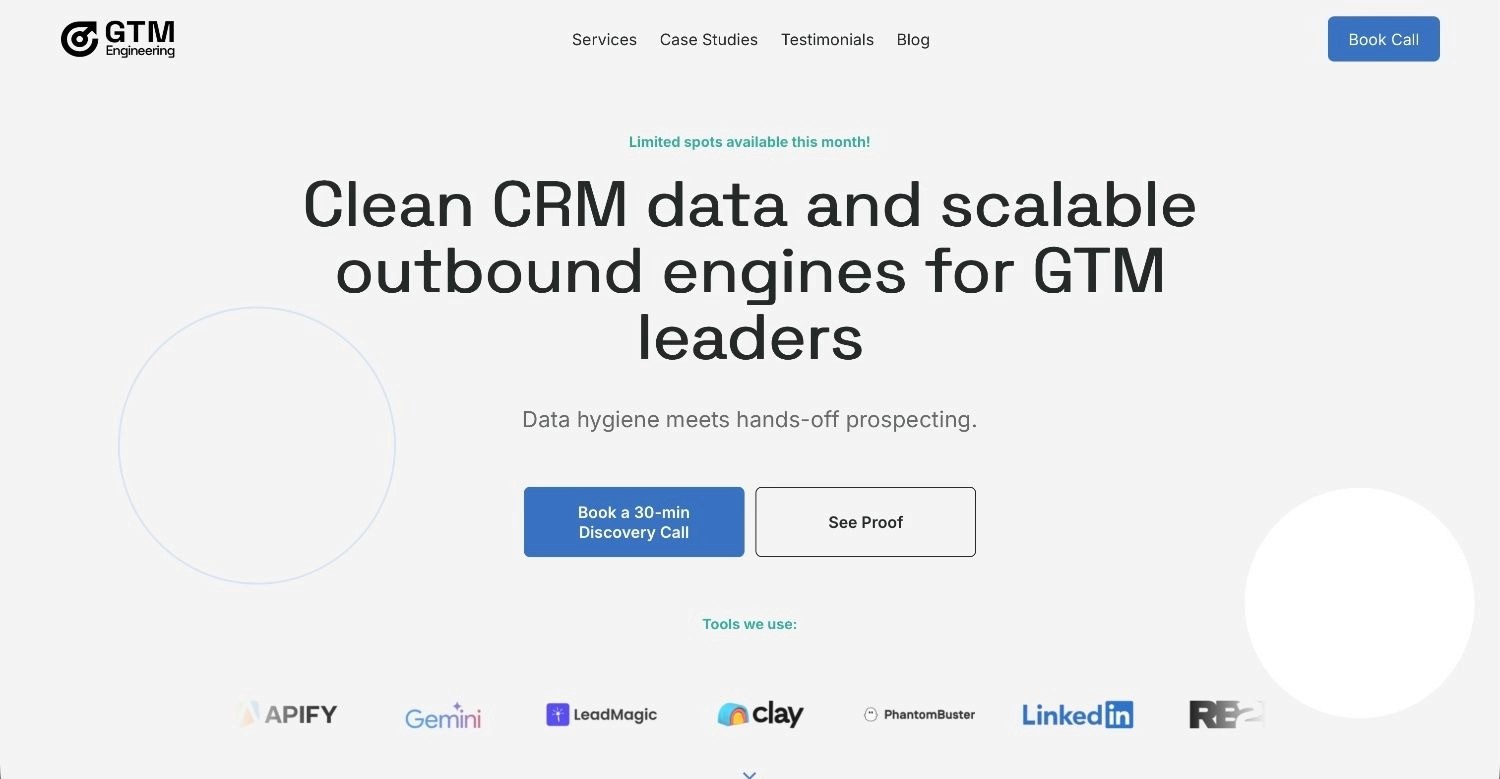
Jorge Macias is a standout expert for those looking to move beyond basic Clay tables into full-scale GTM engineering. As a Y Combinator alumnus and founder of The GTM Engineering Company, Jorge treats Clay as core infrastructure rather than just a data tool. He is widely recognized for building automated revenue machines that integrate Clay with CRM architecture, multi-channel outbound, and live performance dashboards.
Through The GTM Engineering Company, Jorge operates as a fractional GTM engineer, delivering live weekly builds rather than static reports. His methodology focuses on signal-based prospecting, layering firmographic and trigger data to identify high-intent accounts. For those looking to hire, his firm ensures clients retain full ownership of all custom workflows, making automation a permanent internal asset.
Type of Service: Fractional GTM Engineer / Clay Implementation Specialist
Best For: VC-backed B2B SaaS startups ($500K to $10M ARR) needing to bridge the gap between Clay data and CRM execution.
Why It Stands Out: Jorge combines Y Combinator founder credentials with deep technical execution, offering a tool-agnostic architecture that avoids vendor lock-in.
Pros:
Proven founder pedigree with 100+ GTM system implementations for B2B companies.
Full-stack GTM vision connecting Clay to ICP research, CRM configuration, and outbound strategy.
Transparent execution model featuring tiered monthly pricing and hands-on weekly builds.
Commitment to knowledge transfer via SOPs and Loom recordings so teams can operate systems independently.
2. Jordan Crawford: Clay Educator and Signal-Based Prospecting Expert
Jordan Crawford is one of the most respected voices in the Clay community, known for sharing production-ready workflows and technical breakdowns that go beyond surface-level tutorials. His content focuses on signal-based prospecting, using Clay to detect intent triggers like job changes, funding events, tech stack shifts, and website activity, then automating outreach based on those signals.
Crawford combines technical depth with teaching clarity. His LinkedIn posts and workflow teardowns help revenue teams understand not just how to build Clay tables, but why specific enrichment sequences matter for conversion. He's active in Clay communities and frequently engages with technical questions, making him one of the best clay users to follow for staying current on platform updates and advanced tactics.
Type of Service: Content Creator / Consultant
Best For: Revenue leaders and GTM operators who want to learn signal-based prospecting and stay updated on advanced Clay techniques.
Why It Stands Out: Jordan Crawford bridges the gap between education and execution, sharing real systems with measurable results rather than generic tips.
Pros:
Production-ready content with detailed workflow breakdowns and technical explanations
Signal-based prospecting focus that teaches intent-driven automation, not just static list building
Active community engagement responding to questions and sharing emerging Clay tactics
Practical orientation grounded in real GTM challenges, not theoretical best practices
3. Adam Andrewjesky: Clay Best Practices and Workflow Optimization
Adam Andrewjesky is a Clay practitioner and educator known for clear, actionable content on workflow design and platform best practices. He focuses on helping teams avoid common mistakes when building Clay systems, emphasizing clean data architecture, cost-effective enrichment strategies, and maintainable table structures.
Andrewjesky's teaching style prioritizes clarity and repeatability. His content helps both beginners and intermediate users level up their Clay skills without getting lost in overly complex setups.
Type of Service: Clay Practitioner / Educator
Best For: Teams building their first Clay workflows or refactoring existing tables that have become unmanageable.
Why It Stands Out: Adam Andrewjesky makes complex Clay concepts accessible, with a focus on sustainable, scalable workflow design.
Pros:
Best practice orientation that helps teams avoid costly mistakes in data architecture and provider selection
Clear teaching style that breaks down complex workflows into understandable components
Active in Clay communities where he answers technical questions and shares emerging tactics
Focus on maintainability rather than just building impressive one-off tables
4. Tim Yakubson: Clay Education and Implementation
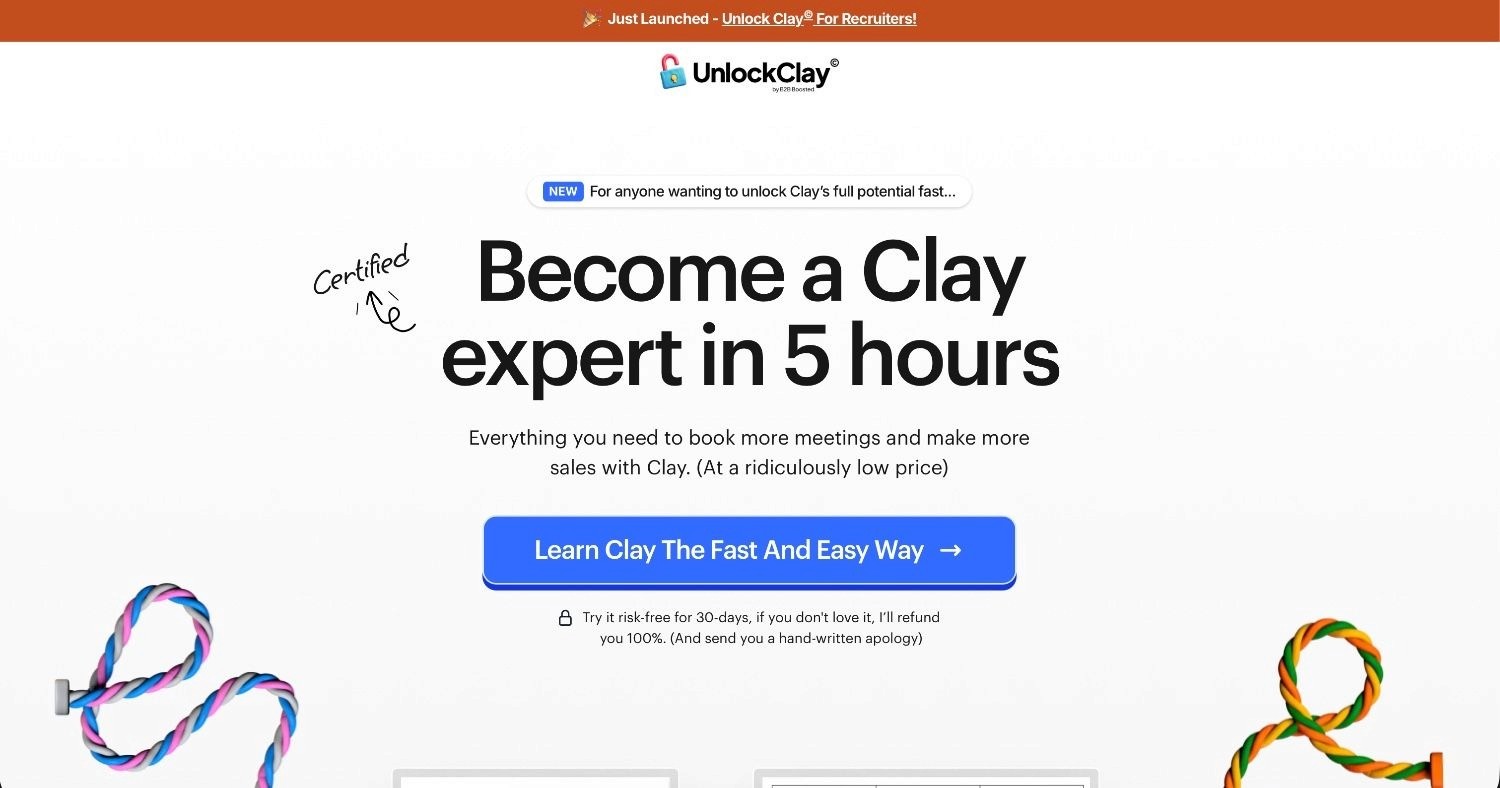
Tim Yakubson runs Unlock Clay, a platform focused on Clay education, templates, and consulting services. He's been publishing consistent content on Clay tactics, workflow strategies, and platform updates, making him a reliable source for staying current on what's possible with the tool.
Unlock Clay combines educational resources with hands-on implementation support. Yakubson's approach emphasizes practical application, helping teams translate Clay concepts into working systems.
Type of Service: Educator / Consultant
Best For: Teams that want structured Clay education combined with implementation support for specific projects.
Why It Stands Out: Tim Yakubson provides consistent, high-quality content output with a focus on practical Clay tactics that teams can implement immediately.
Pros:
Consistent educational content covering Clay features, workflows, and best practices
Practical implementation focus rather than purely theoretical teaching
Template and framework resources that accelerate learning and initial builds
Active platform updates keeping followers informed on new Clay capabilities
5. Eliot Nordstrom: Balanced Clay Educator and Practitioner
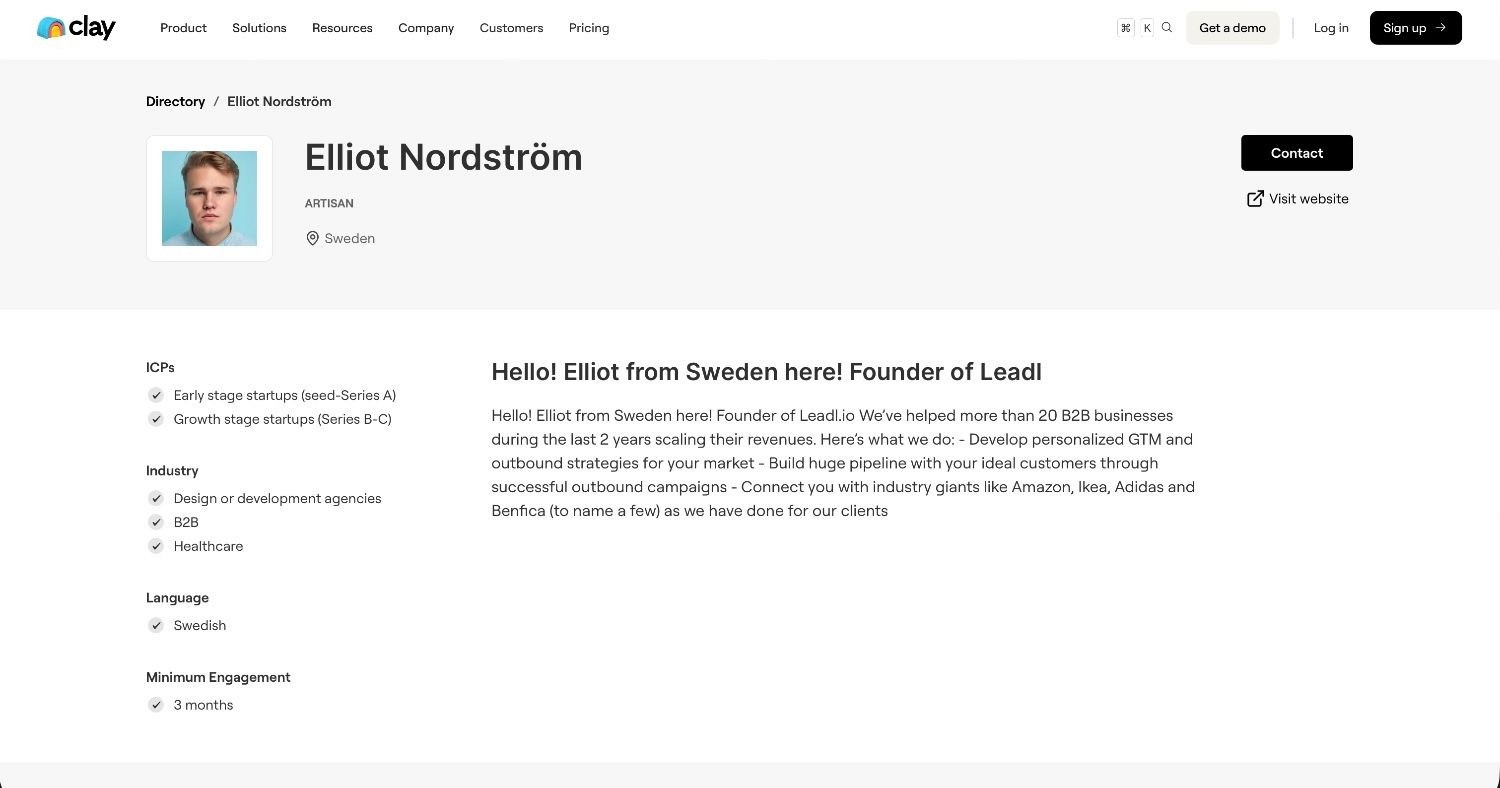
Eliot Nordstrom is a Clay specialist who balances content creation with hands-on consulting work. He shares tactical insights on LinkedIn and in Clay communities while maintaining an active practice building workflows for clients. This combination makes him a valuable follow for teams evaluating whether to learn Clay themselves or hire external help.
Nordstrom's content tends toward practical, implementation-ready advice rather than high-level strategy. He focuses on specific use cases and workflow patterns that solve common GTM challenges.
Type of Service: Consultant / Educator
Best For: Teams that want to follow a Clay expert who actively ships client work and shares real-world learnings.
Why It Stands Out: Eliot Nordstrom demonstrates the balance between teaching and building, offering credibility from active client engagements alongside educational content.
Pros:
Active consulting practice that grounds his educational content in real client challenges
Tactical focus on specific workflows and use cases rather than generic best practices
Community engagement responding to questions and sharing lessons from client work
Balanced approach between education and execution
6. Michael Sarugia: Technical Clay Specialist and API Integrator
Michael Sarugia is recognized for technical depth in complex Clay implementations, particularly around API integrations and custom data sources. He focuses on building robust, scalable workflows that handle edge cases, normalize messy data, and integrate niche industry databases.
Sarugia's expertise is particularly valuable for teams with unique data challenges that generic Clay templates can't solve. His work emphasizes engineering principles applied to data workflows.
Type of Service: Clay Specialist / Technical Consultant
Best For: Companies with complex data needs, industry-specific databases, or technical workflows that require custom API integration.
Why It Stands Out: Michael Sarugia brings software engineering rigor to Clay implementations, building systems that handle complexity and scale.
Pros:
Strong technical depth in API integrations and custom data source connections
Complex workflow capability handling edge cases and data normalization challenges
Engineering mindset that produces maintainable, scalable systems
Industry-specific experience connecting niche databases to Clay workflows
How to Choose the Right Clay Expert for Your Team
1. Define Your Goal: Learning or Implementation
The first decision is whether you need education or execution. If you're evaluating Clay as a tool and want to understand what's possible, start by following content creators like Jordan Crawford, Adam Andrewjesky, and Tim Yakubson. Their tutorials, workflow teardowns, and LinkedIn posts give you the foundation to assess whether Clay fits your GTM motion.
If you've already decided to implement Clay and need systems that ship pipeline, you're hiring for execution. In that case, prioritize consultants with proven client results, custom build capabilities, and knowledge transfer commitments. Look for specialists who show case studies with measurable outcomes: time saved, pipeline generated, conversion rates improved.
Ask yourself: Are we still learning what Clay can do, or are we ready to build production systems that replace manual prospecting? The answer determines whether you follow for inspiration or hire for implementation.
2. Assess Your GTM Maturity and Data Complexity
Teams at different stages need different Clay specialists. If you're a seed-stage startup with a simple ICP and one or two data providers, you may only need basic enrichment workflows. In that case, template-driven agencies like OneAway or educational resources from top clay users may be sufficient.
If you're a Series A or B company with multiple buyer personas, complex tech stack requirements, or industry-specific data sources, you need custom architecture. Look for clay consultants who demonstrate experience integrating niche APIs, building waterfall enrichment logic, and handling edge cases in data normalization.
Companies juggling multiple disconnected tools (Apollo, ZoomInfo, Salesforce, Lemlist) need specialists who think architecturally, not just tactically. The best clay experts at this level treat Clay as infrastructure that unifies your stack, not as another isolated point solution.
Ask yourself: How complex is our ICP? How many data sources do we need to integrate? Do we have niche industry databases that require custom API work? Your data complexity determines whether you need a template expert or a systems architect.
3. Evaluate Teaching Ability and Knowledge Transfer
Even if you're hiring for execution, prioritize clay freelancers and consultants who emphasize knowledge transfer. You don't want to be dependent on an external expert forever. The best engagements deliver working systems plus the training, documentation, and SOPs your team needs to operate independently.
Look for proof of teaching ability in testimonials, case studies, or content. Phrases like "Jorge trained our team" or "We can now maintain this ourselves" signal real knowledge transfer. Avoid consultants who treat their Clay workflows as black boxes or resist documenting their logic.
Educational Clay specialists like Eliot Nordstrom and Adam Andrewjesky demonstrate this balance naturally. Implementation-focused firms like The GTM Engineering Company by Jorge Macias build it into their delivery model through weekly working sessions, Loom recordings, and hands-on training.
Ask yourself: Will we own these systems after the engagement ends? Does this expert provide documentation, training, and ongoing support to make us self-sufficient? Knowledge transfer should be non-negotiable when you hire a clay expert.
4. Look for Full-Stack GTM Thinking, Not Just Clay Mastery
The best clay GTM experts understand that Clay is one component of a revenue system. They know how to connect enrichment workflows to CRM field mappings, email sequence triggers, lead scoring models, and performance dashboards. Specialists with only Clay depth but no CRM, outbound, or RevOps experience will struggle to integrate their work into your existing stack.
Ask potential hires how they've connected Clay to Salesforce, HubSpot, or other CRMs in past projects. Look for examples of bidirectional sync, automated lead routing based on enrichment data, or dashboards that track ROI from Clay-powered campaigns. If a consultant can only talk about Clay tables without mentioning CRM architecture or campaign execution, they're likely a data specialist, not a GTM engineer.
Ask yourself: Does this expert talk about systems and infrastructure, or just Clay features? Can they show examples of Clay workflows integrated with our CRM, sequencer, and reporting tools? Full-stack thinking separates Clay experts from Clay operators.
5. Match Expertise to Your Industry and GTM Motion
Clay workflows for enterprise sales look different from workflows for PLG startups. Intent signals for B2B SaaS differ from signals for real estate or financial services. The best clay consultants demonstrate experience in your industry or with companies at your stage.
If you're selling to developers, look for experts like Jordan Crawford who understand technical buyer personas and GitHub-based intent signals. If you're in financial services, prioritize specialists with compliance experience and familiarity with regulated data providers. For B2B SaaS at Series A, The GTM Engineering Company's track record with VC-backed startups signals domain fit.
Ask potential hires for examples of past work in your vertical. Review their case studies and testimonials for company types similar to yours. Industry-specific expertise accelerates results because the consultant already understands your buyer journey, data landscape, and compliance constraints.
Ask yourself: Has this expert built Clay systems for companies like ours? Do their case studies mention our industry, stage, or GTM motion? Domain expertise reduces ramp time and increases the likelihood of ROI-positive engagement.
Best Clay Experts: Final Comparison
Name / Company | Pricing Model | Core Focus | Key Strengths | Best Use Case |
Jorge Macias (The GTM Engineering Company) | $4K–$6K/month retainer | Full GTM infrastructure + Clay automation | Y Combinator founder, 100+ systems, tool-agnostic, transparent pricing | VC-backed SaaS needing custom Clay + RevOps systems |
Jordan Crawford | Free content / consulting inquiries | Signal-based prospecting education | Production-ready workflows, technical breakdowns, active community | Learning signal-driven Clay automation |
Adam Andrewjesky | Free content / consulting inquiries | Clay best practices and optimization | Clear teaching, workflow maintainability focus | Building first Clay systems correctly |
Tim Yakubson | Educational resources + consulting | Clay education and implementation | Consistent content, practical templates, implementation support | Structured learning + tactical projects |
Eliot Nordstrom | Consulting inquiries | Balanced education and consulting | Active practice, tactical focus, community engagement | Following expert who ships client work |
Michael Sarugia | Consulting inquiries | Technical Clay and API integration | Engineering rigor, complex workflows, custom APIs | Complex data needs and integrations |
Start Building Scalable GTM Infrastructure with The GTM Engineering Company
Every week you wait to implement professional Clay systems costs you pipeline. Your sales team burns 20+ hours per week on manual research. Your CRM data degrades. Your competitors automate faster.
The GTM Engineering Company builds custom Clay automation workflows integrated with full RevOps infrastructure: CRM configuration, multi-channel outbound, ICP research, and performance dashboards. As a Y Combinator-backed fractional GTM engineer with 100+ implemented systems, we deliver enterprise-grade automation for the cost of a junior SDR, but with exponentially greater leverage. We emphasize knowledge transfer, transparent pricing, and weekly hands-on builds that ship qualified pipeline in weeks, not quarters.
Ready to replace manual prospecting with engineered revenue systems? Book a free consultation with The GTM Engineering Company here.
Frequently Asked Questions (FAQs)
What is the difference between a Clay expert and a standard lead generation agency?
The difference between a Clay expert and a standard lead generation agency lies in the shift from manual labor to scalable GTM engineering. While traditional agencies often rely on large teams of junior SDRs to manually scrape lists and send templated emails, a Clay expert architects automated systems that use waterfall enrichment and AI-driven research to achieve higher precision. This technical approach ensures that your data infrastructure is a permanent asset you own, rather than a temporary service that disappears once a contract ends.
How much does it typically cost to hire a top Clay consultant?
How much it typically costs to hire a top Clay consultant generally ranges between $4,000 and $8,000 per month for fractional GTM engineering services. This investment is often structured as a monthly retainer that covers the design, implementation, and maintenance of complex automated workflows and CRM integrations. Compared to the cost of hiring a full-time RevOps manager or multiple SDRs, hiring an expert provides enterprise-grade infrastructure at a fraction of the traditional headcount expense.
Why should I hire a fractional GTM engineer instead of building Clay tables myself?
You should hire a fractional GTM engineer instead of building Clay tables yourself because professional practitioners move beyond basic data lookups to create resilient, interconnected revenue systems. Most DIY users eventually hit a "complexity ceiling" where tables become brittle, API costs spiral out of control, or data fails to sync correctly with the CRM. An expert ensures your architecture is tool-agnostic, cost-optimized, and fully integrated into your existing tech stack from day one.
Can a Clay expert help with CRM integration and data hygiene?
A Clay expert can absolutely help with CRM integration and data hygiene by building bidirectional syncs that keep your HubSpot or Salesforce records updated in real-time. They design "waterfall" logic to ensure only the highest quality data enters your system, preventing the common problem of polluting your CRM with unverified emails or outdated firmographics. By automating the normalization and enrichment process, these specialists transform your CRM from a static database into a dynamic engine for outbound sales.
What is signal-based prospecting and why do experts emphasize it?
Signal-based prospecting is a strategy emphasized by experts because it moves away from "spray and pray" tactics toward reaching out to prospects exactly when they are most likely to buy. Clay experts use the platform to monitor specific triggers—such as new job postings, recent funding rounds, or changes in a company's tech stack—to initiate automated, highly relevant outreach. This methodology significantly increases response rates because the messaging is grounded in real-time business events rather than generic cold pitches.
How long does it take to see results after hiring a Clay specialist?
The time it takes to see results after hiring a Clay specialist is typically between two to four weeks for the initial production-ready workflows to go live. Unlike traditional consulting projects that take months of discovery, Clay experts focus on "live builds" that ship functional pipeline-generating systems almost immediately. Within the first month, most teams see a drastic reduction in manual research time and a measurable increase in the volume of qualified outbound activity.
Do I need to provide my own data provider subscriptions when working with an expert?
Whether you need to provide your own data provider subscriptions depends on the expert's specific model, but most prefer to work within your own Clay workspace so you maintain full ownership of the data. One of the primary benefits of working with a specialist is their ability to optimize your spend across providers like Apollo, Hunter, or PeopleDataLabs using Clay’s native credits. This approach allows you to access dozens of premium data sources without needing individual enterprise contracts for every single tool in the stack.