

Key Takeaways (TL;DR)
Who The Kiln Is For: B2B teams, originally post-PMF growth companies, now trending toward enterprise after The Kiln's January 2026 acquisition by 2X. Their core strength is Clay-native GTM system design: outbound, inbound, and RevOps workflows built by former Clay employees. Post-acquisition, their delivery sits inside 2X's enterprise infrastructure.
Why Seek a The Kiln Alternative: The 2026 acquisition by 2X shifts The Kiln's focus toward enterprise clients requiring large delivery infrastructure. Boutique-style Clay builds and small-team embedded work, which made The Kiln distinctive, now sit inside a much larger managed-services machine. Teams that want a fractional operator embedded in their specific stack, not a subscription to an enterprise GTM service, need a different option.
Best Overall Alternative: The GTM Engineering Company is the best overall alternative. Same Clay-native, CRM-embedded operator model, at the scale and price point that growth-stage B2B SaaS teams actually need. Every deliverable ships with a Loom and an SOP. The team never touches more clients than it can serve with full attention.
What Sets Us Apart?: We’re the only The Kiln alternative on this list which operates as a true embedded fractional GTM engineer inside your CRM, in weekly live working sessions, with every workflow documented and owned by your team at engagement end.
How to Choose?: Three factors: (1) whether you need boutique embedded engineering or a managed service at scale; (2) whether your CRM and outbound stack is already partially built or starting from scratch; (3) whether you want a vendor relationship or a fractional engineer who builds live in front of you and hands it over.
Table of Contents
Top The Kiln Alternatives in 2026 at a Glance
Why Consider The Kiln Alternatives?
Best The Kiln Alternatives: In-Depth Review and Comparison
Why The GTM Engineering Company Works Across Multiple Use Cases?
What Makes a Good The Kiln Alternative?
How to Choose the Right The Kiln Alternative for Your Needs?
Everything You Need to Know About The Kiln Alternatives
Ready to Move On from The Kiln? Try The GTM Engineering Company
FAQs About The Kiln Alternatives
Top The Kiln Alternatives in 2026 at a Glance
Agency | Best For | Key Features | Pros | Cons | Pricing Starts |
|---|---|---|---|---|---|
The GTM Engineering Company | Growth-stage B2B SaaS needing embedded GTM engineering | Clay enrichment, CRM builds, signal-based outbound, AI scoring, attribution | Embedded operator; documented systems; signal-over-volume outbound | Requires an existing GTM motion; not for pre-PMF teams | $4K/month |
Frontal | Post-PMF B2B companies wanting a GTM system built then optionally managed | Data foundation, signal layer, workflow routing, execution layer | 275+ companies served; 90-day build option; "first play live in 30 days" guarantee | Custom pricing; more productized than bespoke | Custom (90-day pilot) |
The Deal Lab | B2B teams needing message-market fit before scaling GTM infrastructure | Messaging experimentation, tech stack, meeting volume and quality | Scientific messaging framework; proprietary tech + messaging stack | Starts at $6,500/month; 4-month minimum | $6,500/month |
Growth Alliance | B2B companies needing full-funnel growth strategy and execution | Growth strategy, experimentation, demand gen, RevOps | Full-funnel coverage; custom-scoped; established track record | No published pricing; discovery required | Custom |
Infinite Skills | B2B teams needing GTM system design and sales acceleration | GTM system architecture, sales process, CRM setup, outbound | Hands-on operator model; team structure-aware | No published pricing; limited public case studies | Custom |
Go Nimbly | Series B+ companies needing full-stack RevOps consulting | RevOps architecture, HubSpot/Salesforce, ops strategy, enablement | Established RevOps brand; broad platform coverage; large team | Project-based fees; generalist RevOps model | Custom |
RevPartners | HubSpot-heavy teams needing RevOps and Clay integration | HubSpot architecture, Clay workflows, pipeline ops, reporting | HubSpot Elite partner; Clay integration; active content presence | No published pricing; discovery required | Custom |
The Workflow Company | B2B teams needing bespoke AI-powered GTM intelligence systems | AI intelligence orchestration, data flows, signal capture, action automation | Custom-built systems; proprietary approach; strong positioning | Advisory starts at $2,500; managed service at $8K/month | $2,500 (advisory) |
SalesCaptain | Full-stack RevOps and GTM teams needing end-to-end build and execution | RevOps architecture, outbound, CRM, ICP definition, channel distribution | Full-stack coverage; custom pricing; multi-channel | No published pricing; broader scope than Clay-native work | Custom |
Why Consider The Kiln Alternatives?
What The Kiln Does Well?
The Kiln was, by any measure, one of the strongest Clay agencies in the GTM engineering category.
Founded in Brooklyn in 2023 by Patrick Spychalski and Mathias Powell, both former Clay employees, the company built its reputation on the technical depth that comes from having people who helped build the tool itself. They also earned Clay’s ‘Elite Studio’ partner status, and counts Windsurf, Sendoso, Browserbase, Loxo and others amongst its clients.
The agency attracted enough market attention the past few years, eventually getting acquired by 2X, a global marketing-as-a-service (MaaS) firm in January 2026.
They’re experts at building custom Clay workflows, enrichment tables, inbound + outbound automations and CRM integrations that actually scale. Clients have appreciated the agency’s fast, technically creative approach and willingness to take on bespoke, complex workflow others refuse.
Over the years, the company has become a go-to for teams that wanted former Clay-employee level expertise in their GTM stack.
Where The Kiln Falls Short?
While The Kiln is still a renowned name in the GTM/Clay agency space, the 2X acquisition has led to a tectonic shift, which you must understand before evaluating any The Kiln alternatives:
Post-acquisition shift towards enterprise: 2X's stated rationale for acquiring The Kiln was to serve enterprise clients who need delivery infrastructure that a boutique cannot provide. That is a legitimate market, but it is a different market. The Clay ecosystem's value was demonstrated with post-seed through Series C B2B SaaS teams, not enterprise firms with 1,300-person delivery organizations. Teams in the growth-stage segment need to evaluate whether the product they are buying still resembles what made The Kiln valuable.
Embedded boutique work sits inside a large managed-services firm: The Kiln's appeal was fractional-engineer-level attention from a small, focused team. That model has structural tension with operating inside 2X's enterprise infrastructure. Clients who want a specific operator embedded in their stack in weekly working sessions may find a different delivery experience than the boutique model The Kiln was known for.
Limited fit for pre-PMF teams: The Kiln explicitly targets post-PMF companies. Teams still searching for message-market fit need a different kind of help first. The GTM Engineering Company holds the same position; it explicitly refers pre-PMF teams to specialists like The Deal Lab.
Project-based and sprint-based models vs. continuous retainer: The Kiln's sprint model and focused weeks of embedded work is valuable for defined projects. Teams that need continuous infrastructure maintenance, CRM governance, and signal architecture running on retainer may find the model less suited to ongoing operational needs than a continuous retainer engagement.
Those dynamics push a growing number of growth-stage B2B teams to evaluate the alternatives to The Kiln that still operate in the boutique, embedded, operator-first model.
Best The Kiln Alternatives: In-Depth Review and Comparison
1. The GTM Engineering Company
Overview
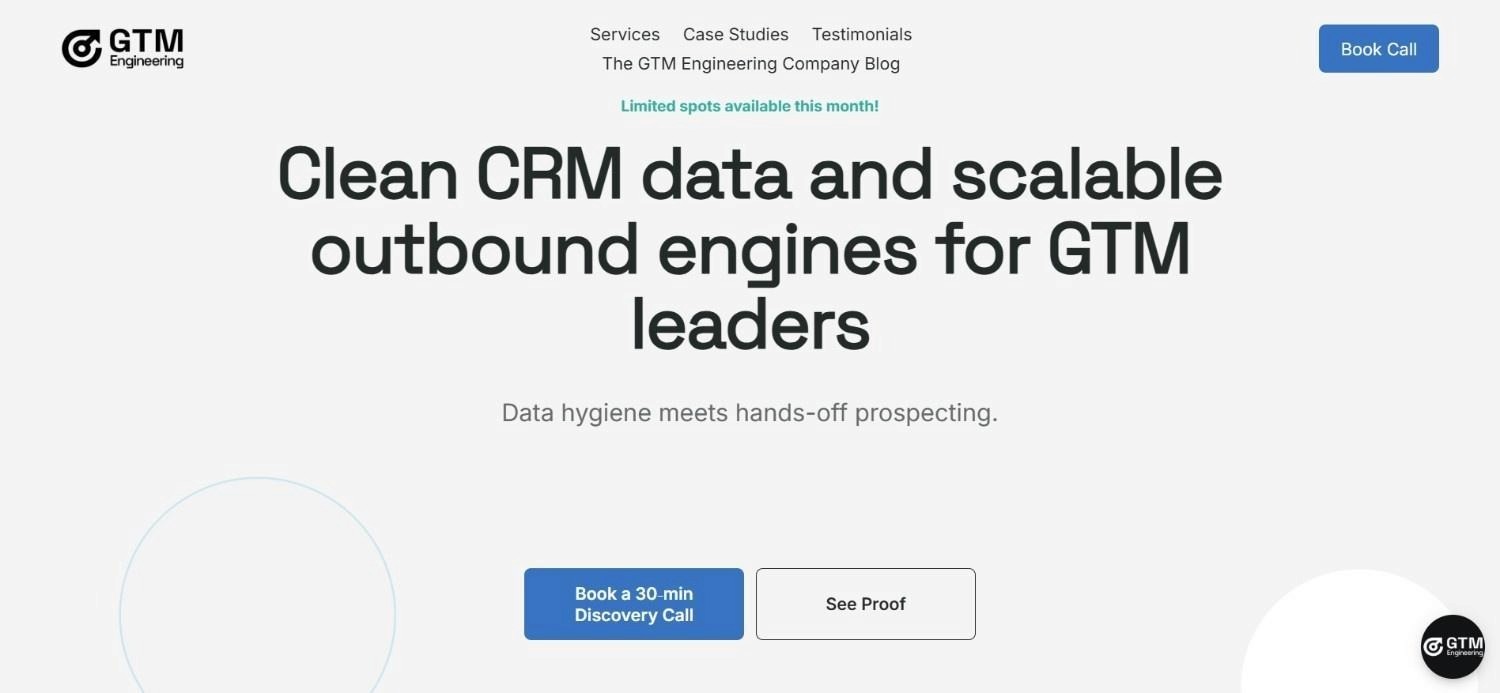
The GTM Engineering Company is not a conventional GTM agency. While most other The Kiln alternatives on this list deliver strategy decks, content and campaign management, we build revenue infrastructure, designing the entire data architecture, setting up signal-based outreach systems and complex Clay enrichment workflows that make a sales motion work at scale.
The company was founded by Jorge Macías, a Y Combinator S18 alumnus and Clay Expert Program member who has implemented 100+ GTM systems and automations and helped 50+ B2B companies build scalable outbound engines leveraging engineering principles to solve complex GTM problems. Every workflow is documented, with systems built inside the client's own stack, and every engagement ends with the client’s team capable of operating and extending the infrastructure independently.
All these factors contribute heavily to The GTM Engineering Company’s standing as one of the best The Kiln alternatives for VC-backed, B2B SaaS teams transitioning from founder-led sales to a scalable, team-operated motion.
Ideal For
Growth-stage B2B SaaS companies (post-seed through Series C, $1M to $30M ARR) that need a fractional GTM engineer embedded in their CRM and outbound stack, not a managed-service subscription
Newly hired or promoted RevOps leaders (3 to 12 months in role) inheriting a fragmented stack who need documented, connected systems rather than one-off contractor builds
Founders and CEOs who have downsized BDR teams and reallocated budget to GTM infrastructure, and want signal-based outbound triggered by real events rather than purchased lists
Teams that have used The Kiln or similar Clay agencies for sprint work and now need continuous infrastructure maintenance, CRM governance, and enrichment running on retainer
Enterprise sales organizations with ABM motions that need account research automated at scale; UiPath reduced research from 2.5 hours to under 15 minutes per account
Top Features
Evergreen Enrichment Infrastructure: A golden enrichment table in Clay that keeps every CRM record current automatically, covering domain, LinkedIn, firmographics, technographics, traffic, funding, hiring signals. Applies to accounts, leads, and contacts continuously, not as a one-time list build.
AI Scoring and Signal Architecture: ICP fit combined with intent signals from LinkedIn engagement, webinars, form activity, product usage, traffic growth, and job changes, structured into a tier model pushed into the CRM and routed to reps.
Documented Systems Ownership: Every workflow ships with a Loom walkthrough and a written SOP. At engagement end, the client's team can operate, extend, and audit the system without us. The opposite of black-box agency work.
Why We're the Best The Kiln Alternative
The Kiln built its reputation on deep Clay expertise, bespoke implementations, and a hands-on, small-team approach.
We’re a direct The Kiln alternative, since we follow the same embedded operator model as them, with weekly sync-up sessions, Clay Expert Program expertise, and systems that clients fully own after the engagement. Every workflow is documented, with no black-box delivery.
Recent engagements include processing 18,000 leads for about $38 at Slate (by routing classification through OpenAI vs. using Clay credits), generating a CCO-level enterprise demo for Fluint in week 1, and reducing UiPath SDRs’ account research from 2.5 hours to under 15 minutes.
Pros
Embedded operator model: work happens live inside the client's CRM in weekly working sessions, not in an async vendor portal
Every deliverable ships with a Loom and a written SOP; the client owns the system when the engagement ends
Signal-based outbound triggers from real events (traffic spikes, job changes, funding rounds) rather than purchased lists
Cost-engineered architecture: enrichment costs treated like infrastructure, not resale margin
Clay Expert Program member, featured on Clay's site as a vetted expert; active in Clay Cafe
Cons
Not for pre-PMF teams; requires a working GTM motion to scale, not one to find
Not a full-service agency; does not cover brand, content, paid media, or event marketing
Discovery call and 30-day audit required before scope is defined; not a self-serve purchase
Pricing
Retainers run 3 or 6 months at $4,000/month (single-workstream builds: CRM cleanup, scoring model, or attribution) or $6,000/month (multiple parallel workstreams: enrichment, scoring, and signal-based outbound).
Weekly working sessions and a CRM audit are included in every retainer.
Final Verdict
The GTM Engineering Company is the right alternative to The Kiln for growth-stage B2B SaaS teams that want the boutique, embedded, operator-first model that made the latter valuable, at the scale and price point that growth-stage teams need.
2. Frontal
Overview
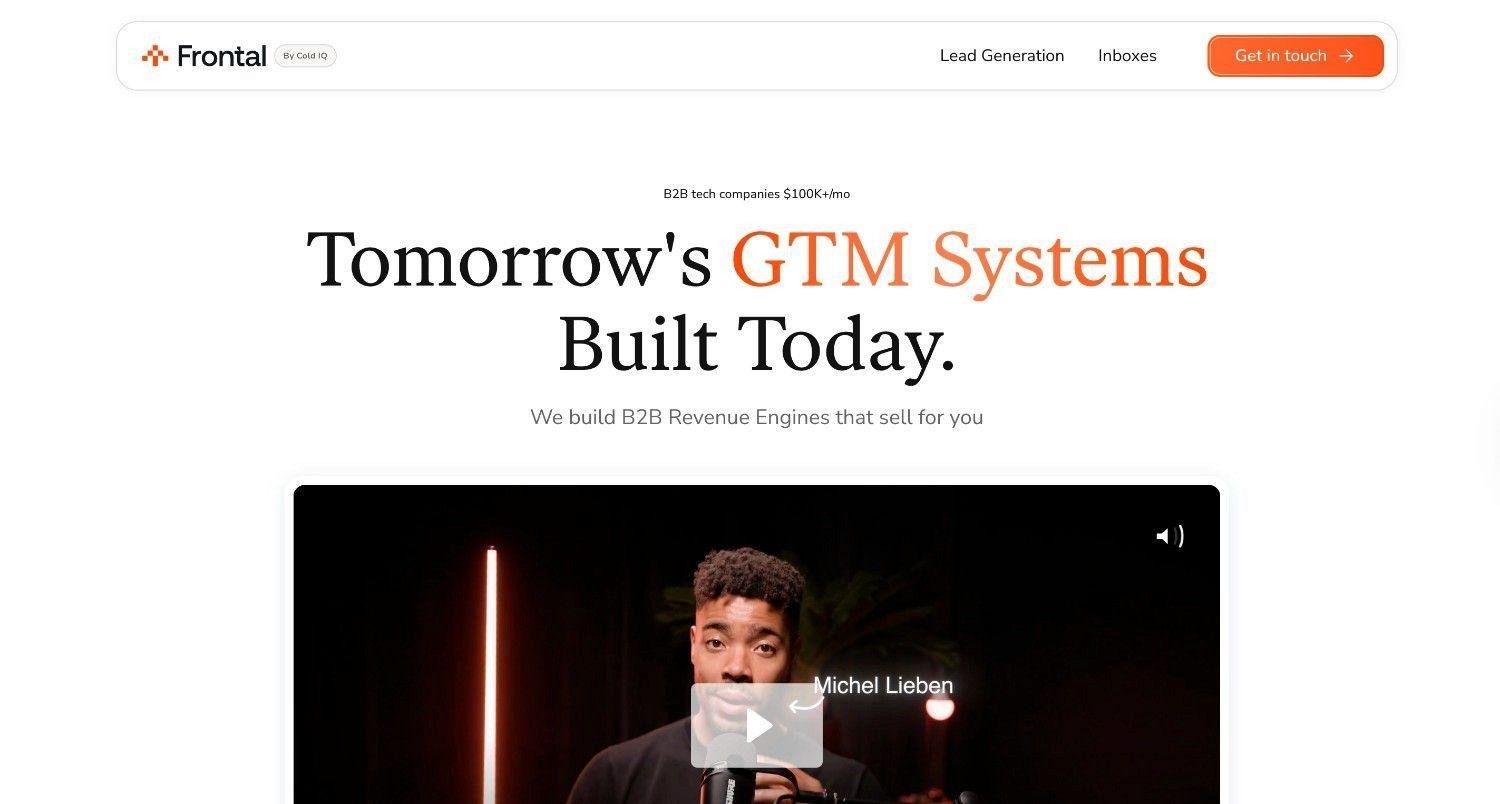
Frontal is a GTM systems firm that builds revenue infrastructure for post-PMF B2B companies, with the option to run the execution layer after the build is complete. It has served more than 275 B2B companies and works with clients including Aircall, Hemlane, Endava, RetellAI, and VTS.
Frontal operates in two modes: a 90-day foundation build covering data foundation, signal layer, and workflow routing, after which the client owns the system; or a monthly execution layer where Frontal's operators run outbound, ads, and content.
Among The Kiln competitors, Frontal is closest to a productized version of the GTM systems build model, with a "first play live in 30 days or your first month is free" guarantee and a risk-averse pilot structure.
Ideal For
Post-PMF B2B companies (typically Series A through Series C) that want a structured 90-day foundation build they can take in-house, with the option to have Frontal run it after
Teams that want a defined, time-boxed GTM system build with a clear handover structure, rather than an open-ended retainer
Growth teams managing messy data, disconnected tools, or weak signal capture who need a foundation layer built before scaling execution
Organizations evaluating The Kiln alternatives that want a risk-averse pilot with a performance-backed guarantee before committing
Revenue-focused founders who want to add GTM infrastructure without adding headcount, with either a self-run or operator-run outcome
Top Features
90-Day Foundation Build: Data foundation (unify, clean, enrich), signal layer (capture intent and engagement signals), and workflow routing (route to the right people with the right context), structured as a defined deliverable the client owns.
Execution Layer Option: After the build, Frontal operators can run outbound, ads, and content on a monthly managed basis, giving teams the option to scale execution without hiring.
First Play Live Guarantee: Frontal commits to the first play being live within 30 days of engagement start, with a free first month if that does not happen.
Why It's a Strong The Kiln Alternative
Frontal is one of the stronger alternatives to The Kiln for teams that want a structured, time-boxed GTM system built with a clear handover and a performance-backed guarantee.
Its 275+ client track record and named client list provide social proof that most boutique alternatives cannot match.
Pros
275+ B2B companies served; strong social proof for a firm in this category
90-day build with a clear handover structure appeals to teams that want to own the system after delivery
"First play live in 30 days" guarantee reduces risk for teams evaluating options for the first time
Cons
More productized than bespoke; teams with complex or unusual GTM stacks may find less flexibility than with embedded operators
Custom pricing with no published rates; requires a discovery call to get scoped
Execution layer managed service may suit some teams, but teams wanting a fractional engineer in their CRM rather than a managed service runner will find a different model here
Pricing
Frontal uses custom pricing with a 90-day risk-averse pilot structure. Pricing is discussed during the discovery and scoping process.
Final Verdict
Frontal is a solid The Kiln alternative for post-PMF B2B teams that want a defined 90-day GTM foundation built with a clear handover option and a performance-backed guarantee.
It is less suited for teams that want a fractional engineer embedded in weekly working sessions building continuously inside their specific stack.
3. The Deal Lab
Overview
The Deal Lab is a B2B GTM agency that positions itself around a specific, earlier-stage problem: finding message-market fit before scaling GTM investment.
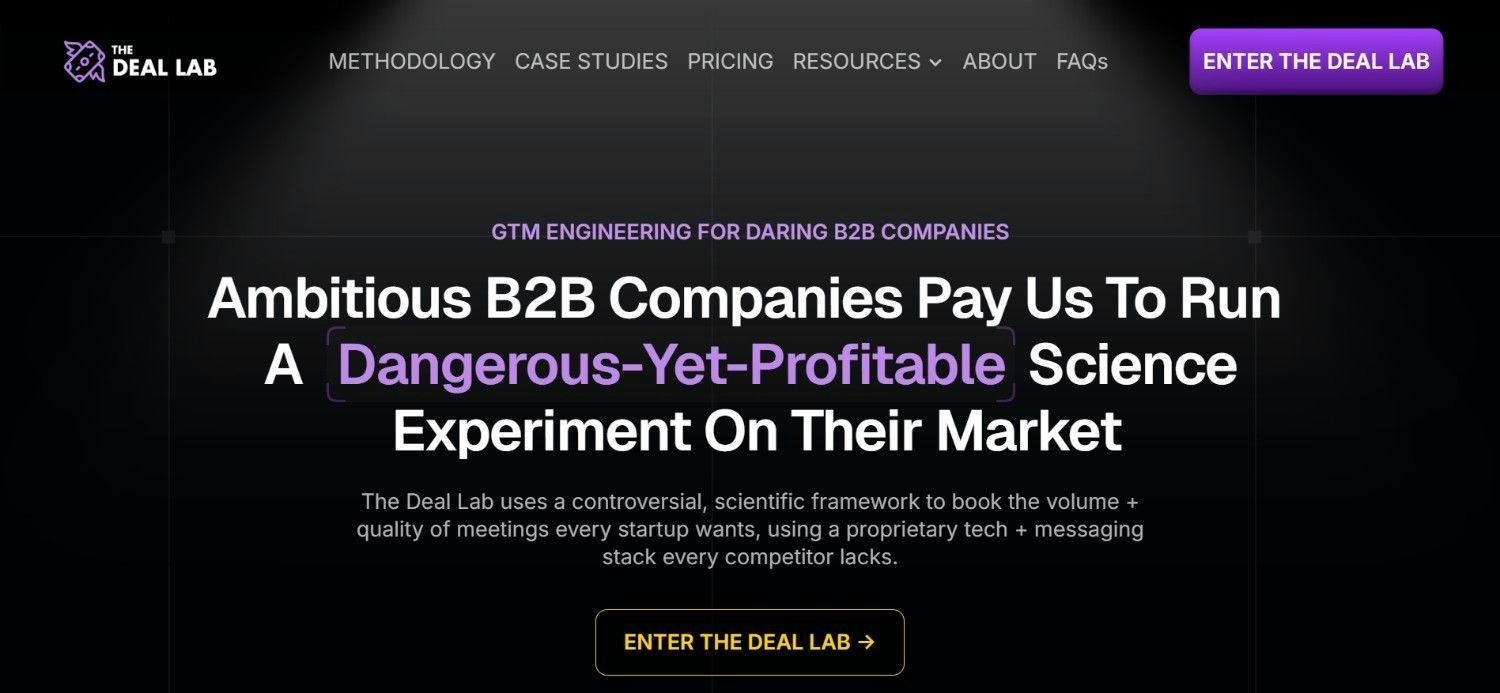
Founded by Kellen Casebeer, and operating under the “dangerous-yet-profitable science experiment on your market" positioning, The Deal Lab runs a proprietary messaging experimentation framework designed to produce volume and quality of meetings through iterative, data-driven messaging iteration before infrastructure is built.
Among the top The Kiln competitors, The Deal Lab occupies a distinct position, and has been recognized by industry leaders like Smartlead, OutboundSync and HeyReach among others.
The agency is an ideal fit for pre-PMF companies, or those whose outbound motion has messaging as a key constraint.
Ideal For
B2B companies that have a working product but have not yet validated which message drives pipeline; pre-PMF or early post-PMF
Founders and GTM leaders who are spending on outbound or inbound without a clear signal of what is resonating, and need to run a structured messaging experiment before building infrastructure
Teams evaluating The Kiln alternatives where the constraint is message-market fit, not system design or CRM infrastructure
B2B SaaS companies that want a scientific, experiment-driven approach to outbound before committing to a full RevOps or enrichment build
Revenue leaders who have invested in tools and enrichment but still cannot identify why their outbound is not converting
Top Features
Messaging Experimentation Framework: A proprietary, structured process for testing and validating messaging through controlled outbound experiments before scaling investments.
Proprietary Tech + Messaging Stack: The Deal Lab builds and runs its own technology and messaging layer, giving clients an edge that cannot be easily replicated by switching to a standard tool stack.
Meeting Volume and Quality Optimization: Focused on producing the specific combination of meeting volume and meeting quality that makes pipeline predictable.
Why It's a Strong The Kiln Alternative
The Deal Lab is among the strongest The Kiln alternatives for teams where messaging, not infrastructure is the bottleneck.
While an agency like The Kiln or The GTM Engineering Company focus on building systems that scale a working GTM motion, The Deal Lab is a great addition if you’re still looking to validate the motion.
Pros
Proprietary messaging experimentation framework addresses a gap that Clay agencies and RevOps firms typically do not cover
Scientific, data-driven approach to message-market fit reduces the risk of scaling the wrong message
Strong founder and operator community presence through content and methodology transparency
Cons
Starts at $6,500/month for a 4-month engagement; higher entry price than most alternatives
Focused specifically on message-market fit and outbound experimentation; not a CRM build, enrichment, or signal architecture firm
Not the right choice once message-market fit is established and infrastructure is the constraint
Pricing
The Deal Lab starts at $6,500/month for a 4-month engagement, with the 6-month engagement at $8,500/month. Enterprise-tier solutions are available at custom pricing.
Final Verdict
The Deal Lab is the right The Kiln alternative for pre-PMF or early post-PMF B2B teams where the constraint is message-market fit, not CRM infrastructure or Clay automation.
It is not suited for teams that already have a working outbound motion and need operational GTM engineering to scale it.
4. Growth Alliance

Overview
Growth Alliance is a full-funnel growth consultancy and execution firm serving B2B companies across demand generation, RevOps, and growth strategy.
As a key The Kiln competitor with broader coverage, Growth Alliance brings together growth strategy, experimentation frameworks, and execution across inbound, outbound, and lifecycle marketing. It operates through a custom-scoped discovery model rather than fixed packages, positioning itself for companies with defined growth objectives and budgets to match a full-funnel partner.
The company’s client work spans B2B SaaS companies at various growth stages, and they’re positioned as a strategic partner rather than a tool-specific implementation agency.
Ideal For
B2B companies that need a full-funnel growth partner covering demand generation, RevOps, growth strategy, and experimentation rather than a narrow tool-specific implementation
Organizations evaluating The Kiln alternatives where the constraint spans multiple functions (marketing, sales, ops) rather than a single CRM or outbound build
Series B and beyond B2B companies with established teams and the budget to engage a full-funnel consultancy at custom scope
Marketing and revenue leaders who need strategic advisory alongside execution, not just technical implementation
Teams that want an established firm with a track record across multiple growth levers rather than a Clay-native specialist
Top Features
Full-Funnel Growth Strategy: Strategy and execution spanning inbound, outbound, demand generation, and lifecycle marketing rather than a single workstream.
Experimentation Framework: Structured experimentation across growth channels to identify and prioritize what moves the needle for each client's specific situation.
Custom-Scoped Engagements: Every engagement is scoped through a discovery process based on the client's specific growth objectives, not applied from a fixed template.
Why It's a Strong The Kiln Alternative
Growth Alliance is among the more relevant alternatives to The Kiln for B2B companies where the growth constraint spans multiple functions.
Its full-funnel coverage is broader than Clay-native GTM engineering firms, which makes Growth Alliance a stronger fit when the problem isn’t specifically CRM infrastructure or outbound automation.
Pros
Full-funnel coverage spans demand gen, RevOps, growth strategy, and experimentation
Custom-scoped engagements avoid the constraint of fixed packages
Established track record across multiple B2B growth stages
Cons
No published pricing; discovery required before any cost estimate
Broader scope than Clay-native engineering means less depth on specific Clay, enrichment, or signal architecture work
Strategic advisory element may add overhead for teams that need operators building in the stack rather than consultants recommending
Pricing
Growth Alliance does not publish fixed pricing. Engagements are custom-scoped based on each client's growth objectives, with pricing determined through a discovery process.
Final Verdict
Growth Alliance is a solid The Kiln alternative for B2B companies that need full-funnel coverage across multiple growth levers rather than a focused Clay and CRM engineering build.
It is not suited for teams that specifically need an embedded GTM engineer running enrichment, scoring, and signal-based outbound inside their existing CRM stack.
5. Infinite Skills
Overview
Infinite Skills is a GTM systems and sales acceleration firm serving B2B companies that need custom GTM architecture, CRM setup, and outbound built alongside coaching and process design.
As one of the key competitors of The Kiln in the hands-on implementation category, Infinite Skills combines system design with team enablement, covering GTM architecture, sales process, CRM setup, and outbound frameworks.
It operates through custom-scoped engagements with pricing determined during the discovery process, targeting companies that need both the technical build and the team capability to run the motion.
Their hands-on operator model is positioned as a crossover between a full-service agency and hiring a fractional consultant.
Ideal For
B2B companies that need GTM system design and CRM setup alongside sales process coaching and team enablement
Organizations evaluating The Kiln alternatives where the constraint is both technical implementation and the internal team's capacity to run the systems after delivery
Growth-stage teams that want a partner who can build the system and teach the team simultaneously, rather than just delivering a system
Companies with non-standard or complex GTM situations that require bespoke architecture rather than a productized template
Revenue leaders who want operator credibility alongside technical delivery
Top Features
GTM System Architecture: Custom design of the full GTM stack covering CRM structure, enrichment approach, outbound architecture, and signal capture tailored to the client's specific situation.
Sales Process Design: Build and documentation of repeatable sales processes alongside the technical infrastructure, addressing both the system and the motion it supports.
Team Enablement: Coaching and training built into the engagement so the client's team can operate and extend what was built.
Why It's a Strong The Kiln Alternative
Infinite Skills is amongst the more practical alternatives to The Kiln for teams seeking GTM system design with team enablement built in.
Its operator model and focus on custom architecture rather than templated delivery aligns with what made The Kiln valuable for bespoke builds.
Pros
Operator-model delivery with coaching and enablement built in
Custom architecture approach rather than templated delivery
CRM setup and outbound design covered alongside team enablement
Cons
No published pricing; requires discovery to understand cost
Limited public case studies and social proof compared to larger alternatives
Scope is broader than Clay-native technical depth; less specialized on enrichment cost engineering and signal architecture specifically
Pricing
Infinite Skills does not publicly disclose pricing.
Costs are customized based on scope, team structure, and GTM requirements, discussed during the discovery process.
Final Verdict
Infinite Skills is a practical The Kiln alternative for B2B companies that need GTM system design alongside team enablement.
It is less suited for teams that specifically need Clay-native technical depth, evergreen enrichment infrastructure, or signal-based outbound built by an operator with documented case studies at scale.
6. Go Nimbly
Overview
Go Nimbly is one of the most established RevOps consultancies in the B2B SaaS market, known for its work with high-growth technology companies including Zendesk, DocuSign, and Twilio.
As one of the larger The Kiln competitors in the ‘RevOps’ category, Go Nimbly covers the full RevOps architecture stack: HubSpot and Salesforce implementation, marketing operations, sales enablement, customer success operations, and RevOps strategy.
Its team size (50 to 200 employees) and established brand give it the bandwidth to staff parallel workstreams across complex RevOps projects that smaller firms cannot handle concurrently.
Ideal For
Series B and above B2B SaaS companies that need full-stack RevOps consulting with parallel workstreams across HubSpot, Salesforce, marketing ops, and sales enablement
Organizations evaluating The Kiln alternatives where the constraint is RevOps architecture across multiple systems, not specifically Clay enrichment or signal-based outbound
Enterprise-leaning technology companies that want a recognized RevOps brand on their vendor roster with established HubSpot and Salesforce implementation credentials
Revenue operations leaders who need a partner with the headcount to staff multiple workstreams simultaneously without bottlenecks
Companies that have outgrown fractional or boutique options and need an established firm with enterprise client references
Top Features
Full-Stack RevOps Architecture: Design and implementation across HubSpot and Salesforce, marketing operations, sales enablement, and customer success operations as a connected system.
Strategic Advisory Layer: GTM strategy and RevOps advisory alongside technical implementation, giving revenue leaders both the roadmap and the build.
Established Client Track Record: Work with Zendesk, DocuSign, Twilio, and similar enterprise SaaS companies provides reference-grade credibility for procurement teams.
Why It's a Strong The Kiln Alternative
Go Nimbly is one of the stronger competitors of The Kiln for Series B and above companies that need full-stack RevOps consulting at scale.
Its established brand and enterprise client track record carry weight in procurement processes that boutique alternatives cannot match on brand alone.
Pros
Established RevOps brand with enterprise SaaS client references (Zendesk, DocuSign, Twilio)
Full-stack RevOps coverage across HubSpot, Salesforce, marketing ops, and sales enablement
Team size supports parallel workstreams that boutique operators cannot handle concurrently
Cons
Project-based fees with no published pricing; discovery required
Generalist RevOps model with Clay bolted on as a tool rather than Clay-native operator depth
Templated execution optimized for repeatable delivery rather than bespoke builds
Pricing
Go Nimbly charges project-based fees with no published fixed pricing. Engagements are scoped during the discovery process.
Final Verdict
Go Nimbly is a strong The Kiln alternative for companies at the Series B stage and beyond, who need full-stack RevOps consulting with established brand credibility and enterprise references.
It is not suited for growth-stage teams needing boutique Clay engineering, signal architecture, or embedded operator work at the $4K to $6K monthly retainer scale.
7. RevPartners
Overview
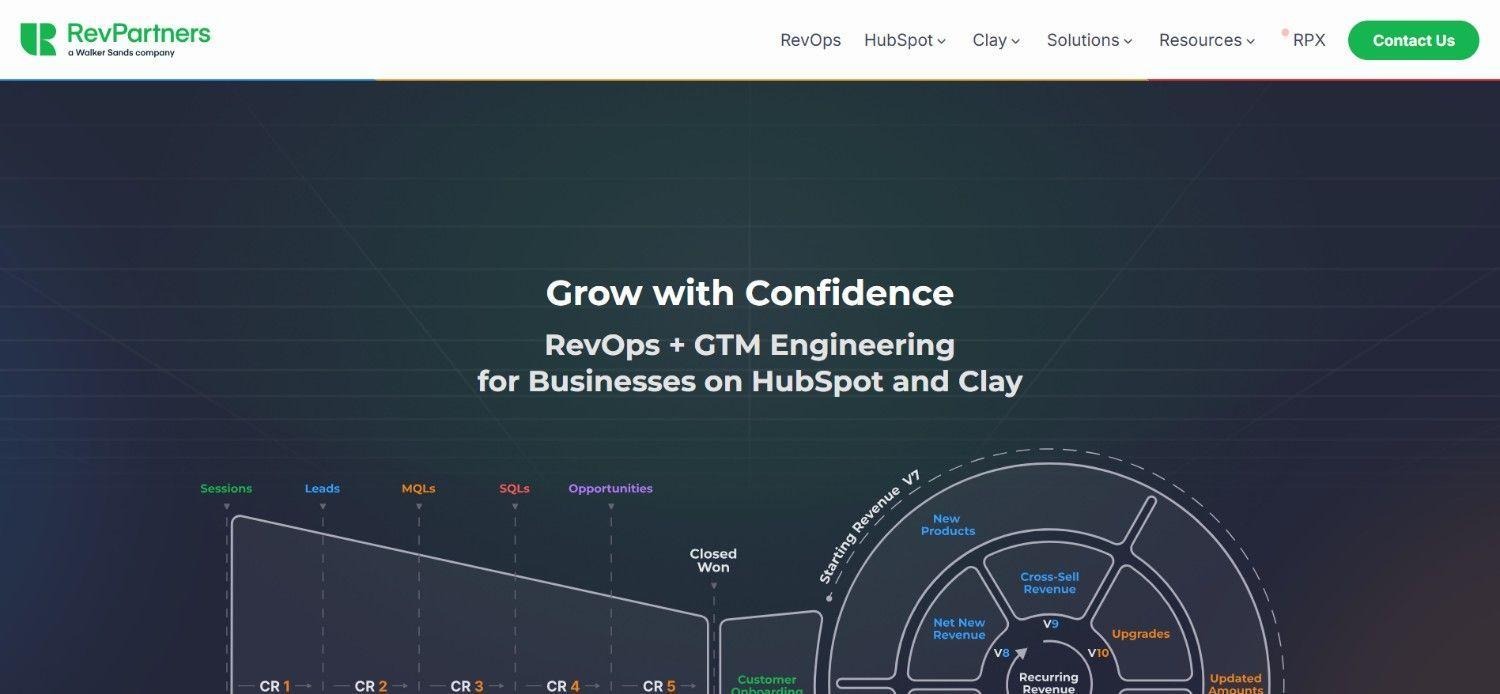
RevPartners is a RevOps agency with a strong HubSpot focus and an active presence in the Clay ecosystem.
As one of the larger The Kiln competitors, RevPartners combines its ‘HubSpot Elite Partner’ status with Clay integration capability; covering pipeline operations, reporting, HubSpot architecture, and Clay workflow builds.
Over the years, the agency has built significant brand recognition among HubSpot-centric RevOps buyers, and also entered the Clay market by bolting their expertise onto an existing HubSpot service line.
This gives them broader coverage, but a different foundation compared to any Clay-native RevOps/GTM engineering firms.
Ideal For
HubSpot-heavy teams that need RevOps architecture, pipeline operations, and Clay integration from a single vendor with HubSpot Elite Partner credentials
Organizations evaluating The Kiln alternatives within the HubSpot ecosystem that want an established firm with community credibility
Series A through Series C B2B SaaS companies that have HubSpot as their CRM of record and want RevOps consulting alongside Clay workflow implementation
Revenue operations leaders who want a partner with strong content and community presence to validate their vendor choice internally
Teams that need both HubSpot architecture and Clay-based enrichment covered under one engagement without managing two separate vendors
Top Features
HubSpot Architecture: Full HubSpot RevOps implementation covering lifecycle stages, pipeline configuration, reporting, and automation, as an Elite HubSpot Partner.
Clay Integration: Clay workflow builds and enrichment integrated into HubSpot, connecting data enrichment to existing HubSpot processes and reporting.
RevOps Co-op Community: Active community platform covering RevOps education and best practices, providing ongoing learning resources for clients and prospects.
Why It's a Strong The Kiln Alternative
RevPartners is one of the more practical alternatives to The Kiln for HubSpot-centric teams that need both RevOps architecture and Clay integration from a vendor with established industry credentials.
Its social presence, alongside an all-bound approach to demand generation provides enough proof of expertise which many boutique alternatives typically don’t match.
Pros
HubSpot Elite Partner status provides strong credentials for HubSpot-centric procurement processes
Active RevOps Co-op community adds ongoing education value beyond project delivery
Clay integration alongside HubSpot architecture reduces the need for separate vendors
Cons
No published pricing; discovery required
Clay bolted onto an existing HubSpot service line rather than Clay-native operator depth
Large team model optimizes for repeatable delivery rather than deeply bespoke builds
Pricing
RevPartners does not publicly share pricing information. Engagements are scoped based on each client's use case (HubSpot, Clay, RevOps) and pricing is discussed during the discovery process.
Final Verdict
RevPartners is a solid The Kiln alternative for HubSpot-heavy teams that need RevOps architecture and Clay integration from a single vendor with HubSpot Elite credentials.
It is less suited for teams that want deeply bespoke Clay-native engineering, signal architecture, or the embedded operator model of a fractional GTM engineer.
8. The Workflow Company
Overview
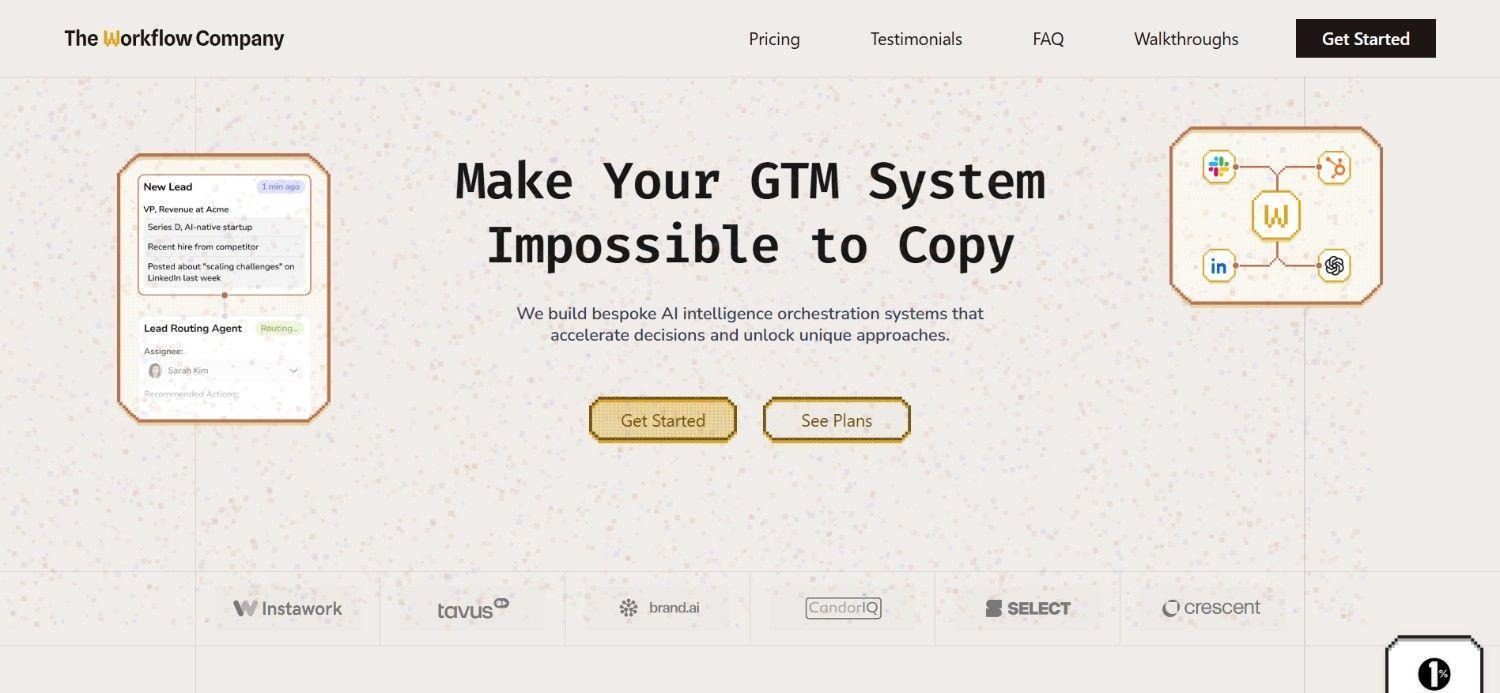
The Workflow Company builds bespoke AI intelligence orchestration systems for B2B companies that want a GTM approach that cannot be copied. Rather than applying standard playbooks, it focuses on custom data orchestration, proprietary intelligence generation, and trigger-based action automation that surfaces buying signals unique to each client's market position.
Among competitors of The Kiln, The Workflow Company occupies a distinct niche: custom-built systems designed to create competitive moats rather than operational efficiency alone.
It covers data orchestration from sales calls and support tickets, AI-powered pattern recognition from win/loss data, buyer intent detection, and multi-channel action automation triggered by real-time signals.
Ideal For
B2B companies that want a GTM intelligence system built around their unique perspective and proprietary signals, not a standard enrichment and outbound playbook
Revenue leaders who have run standard GTM motions and want to build a competitive moat through custom signal capture and intelligence generation
Organizations evaluating The Kiln alternatives where the goal is differentiation rather than operational cleanup or enrichment infrastructure
Teams with specific, unusual signal sources (support ticket patterns, win/loss data, custom intent signals) that require bespoke orchestration rather than standard Clay tables
B2B companies at a stage where standard GTM playbooks are well-executed and the next layer is custom intelligence infrastructure
Top Features
Bespoke AI Intelligence Orchestration: Custom-built systems that extract intelligence from unusual sources (sales calls, support tickets, internal knowledge) and route it into GTM decisions.
Proprietary Signal Capture: Buyer intent detection using signals that only the specific client can access, creating systems that cannot be replicated by competitors running standard tools.
Multi-Channel Action Automation: Trigger-based workflows that respond to real-time buying signals across the full GTM stack.
Why It's a Strong The Kiln Alternative
The Workflow Company is amongst the few, technically distinctive alternatives to The Kiln for teams that want custom intelligence infrastructure rather than standard enrichment and outbound.
Its emphasis on proprietary signal capture and bespoke orchestration is genuinely differentiated from productized Clay agencies.
Pros
Bespoke AI intelligence systems focused on creating competitive differentiation, not just operational efficiency
Proprietary signal capture approach uses signals competitors cannot access
Strong positioning around making GTM "impossible to copy"
Cons
Advisory starts at $2,500 (5 hours at $500/hour); managed service is $8,000/month; custom projects start at $30,000 minimum
Positioned toward more established companies with defined GTM motions; less suited for teams that need foundational CRM cleanup or basic enrichment infrastructure first
Custom build approach requires a longer scoping and discovery process than retainer-based alternatives
Pricing
The Workflow Company's advisory starts at $2,500 for 5 hours ($500/hour). The Outbound Engine managed service is $8,000/month.
Custom build projects start at a $30,000 minimum on a project basis.
Final Verdict
The Workflow Company is a strong The Kiln alternative for established B2B companies that want bespoke AI intelligence orchestration as a competitive moat.
It is not suited for growth-stage teams that need foundational CRM cleanup, evergreen enrichment, or basic signal architecture before building proprietary intelligence systems.
9. SalesCaptain
Overview
SalesCaptain is a full-stack RevOps and GTM agency covering ICP definition, outbound, CRM architecture, channel distribution, and team-level GTM execution. As one of the broader competitors of The Kiln in the GTM services market, SalesCaptain takes a comprehensive approach that spans both strategy and execution across multiple channels and team structures.
It does not publish fixed pricing, preferring to scope engagements based on client requirements, team size, ICP, and channel distribution, all of which reflects in its custom, full-scope model.
SalesCaptain serves teams at various stages that need end-to-end GTM coverage rather than a specific tool-focused workstream.
Ideal For
B2B teams that need full-stack GTM coverage spanning ICP definition, outbound, CRM setup, and multi-channel execution from a single vendor
Organizations evaluating The Kiln alternatives where the constraint spans multiple GTM functions rather than a specific Clay or enrichment workstream
Revenue leaders who want strategy and execution combined in one engagement without managing separate strategy and implementation vendors
Companies at growth stage or beyond that need a comprehensive GTM system designed around their specific ICP, channels, and team structure
Teams that have tried point solutions across separate vendors and want a single partner to own end-to-end GTM architecture and execution
Top Features
Full-Stack GTM Coverage: ICP definition, outbound system design, CRM architecture, and multi-channel distribution covered as a connected engagement rather than separate workstreams.
Custom ICP and Channel Architecture: GTM systems designed around each client's specific buyer profile, channels, and team structure rather than applied from a template.
Execution Alongside Strategy: SalesCaptain covers both the planning and the building, reducing the gap between strategic recommendation and working system.
Why It's a Strong The Kiln Alternative
SalesCaptain is amongst the more comprehensive alternatives to The Kiln, making it suitable for teams that need full-stack GTM coverage with strategy and execution combined.
Its breadth makes it a practical option for companies that find The Kiln's Clay-native focus narrower than their multi-function GTM needs.
Pros
Full-stack GTM coverage addresses ICP definition, outbound, CRM, and channel distribution in a single engagement
Strategy and execution combined under one vendor reduces coordination overhead
Custom scoping accommodates non-standard GTM situations
Cons
No published pricing; custom-scoped based on requirements, team size, ICP, and channels
Broader scope than Clay-native engineering; less specialized on enrichment cost engineering, evergreen Clay tables, or signal architecture specifically
Full-stack model may be more engagement overhead than teams that need a focused single workstream
Pricing
SalesCaptain does not publish fixed pricing. Engagements are scoped and priced based on requirements, team size, ICP, channel distribution and other relevant factors.
Final Verdict
SalesCaptain is a solid The Kiln alternative for teams that need full-stack GTM coverage beyond the Clay-native and CRM engineering focus.
It is not suited for teams specifically seeking an embedded fractional engineer running enrichment, signal architecture, and documented workflows inside their existing CRM.
Why The GTM Engineering Company Works Across Multiple Use Cases?
The alternatives above cover the full range of The Kiln competitors, from boutique GTM systems firms to full-stack RevOps consultancies.
While they vary in model and focus, the use cases below show specifically where The GTM Engineering Company fits best:
1. The GTM Engineering Company for Teams Exiting Kiln Engagements
The most common profile that finds us after working with The Kiln or similar Clay agencies is a growth-stage team that had a successful sprint engagement but now needs continuous infrastructure running on retainer.
Sprint builds are valuable for defined projects. What they leave behind is a system that needs maintenance, governance, and iteration as the company's ICP, signals, and stack evolve. Our retainer model is built for exactly that. The 6-month engagement covers training the client's team to own the system, not just delivering it.
Every workflow is documented and handed over. The client is not dependent on us when the retainer ends.
2. The GTM Engineering Company for Post-Seed to Series C B2B SaaS
Our highest-fit segment is VC-backed B2B SaaS companies from post-seed through Series C, $1M to $30M ARR. These are the teams for which the Clay ecosystem originally proved its value, and the segment where post-acquisition The Kiln has moved away from.
At Fluint (AI sales enablement, Series A), we scored 10,000+ contacts, simplified a 20-stage broken lifecycle, and generated a CCO-level enterprise demo at Bloomreach within week 1.
Contrastingly, for Spara (Series A HubSpot): we built the full master enrichment table, automatic tiering, and inbound intelligence infrastructure.
Similarly, at WebAI, we recovered 1 in 5 inbound leads as qualified ICP by de-anonymizing personal-email submissions.
3. The GTM Engineering Company for Signal-Based Outbound
Most outbound programs at growth-stage SaaS companies share the same problem: they run against purchased lists at volume, burning domains and producing noise. The Kiln alternatives that offer outbound execution typically use the same model.
We take a different approach. Sequences trigger from real events: 20%+ month-over-month traffic growth, new RevOps hire at a target account, funding round, product-usage spike, contact job change. Micro-campaigns over volume.
At NodeSource, we built a high-conversion outbound engine using Reo.dev for GitHub repo analysis as a buying signal, a source that generic outbound agencies do not reach.
4. The GTM Engineering Company for CRM Cleanup and Attribution
Inherited CRM debt is the single most common problem we encounter. Duplicate records, broken contact-to-account linkage, stale employment data (40 to 60% of contacts no longer at their company), and attribution models that marketing and sales argue about because the underlying data is incomplete.
At Slate, we enriched 6,000 Salesforce accounts, processed 18,000 leads for roughly $38, and built an operational LinkedIn scoring model for a team transitioning from B2C to B2B with clients including the Dallas Mavericks.
Similarly, at Spara, we built a 4-category attribution model separating marketing-sourced, sales-sourced, marketing-influenced, and sales-influenced pipeline and backfilled enrichment for roughly 6,800 companies.
5. The GTM Engineering Company for Enterprise Account Research at Scale
Our work with UiPath demonstrates what is possible when signal architecture meets enterprise sales at scale. Enterprise SDRs were spending 2.5 hours per account researching 100 accounts per quarter.
We built an AI-driven account research workflow covering firmographic enrichment, role hierarchy mapping, industry and department classification, and multilingual personalization.
Research time dropped to under 15 minutes per account, saving roughly 250 hours per rep per quarter and roughly $18,000 in labor value.
What Makes a Good The Kiln Alternative?
Not every The Kiln alternative solves the same problem. The right criteria depend on what The Kiln did or did not give you.
Here are the five that matter most:
1. Operator Model vs. Agency Delivery
The Kiln's value was operator-level technical depth from a small, focused team.
The most important question for any alternative is whether the person doing the work is embedded in your stack in live working sessions, or whether they are delivering output asynchronously from a vendor portal.
Most agencies on this list are the latter. The former produces a fundamentally different result.
2. Documentation and System Ownership
The Kiln's SOP and documentation standard was a genuine differentiator. At the conclusion of the engagement, the client's team should be able to run and extend the system without the agency. Not every alternative meets this standard.
If system ownership matters, ask specifically how documentation is handled and what happens when the engagement ends.
3. Clay-Native Technical Depth vs. Clay as a Tool
There is a meaningful difference between an agency that uses Clay and an agency built by people who built Clay. The Kiln has the latter, while most alternatives have the former.
Clay-native depth matters for bespoke builds, complex enrichment architectures, and edge cases. Evaluate how long the team has used Clay and whether they have contributed to the Clay ecosystem.
4. Signal Architecture vs. List-Based Outbound
Most outbound agencies, including many that position themselves as strong The Kiln alternatives, run sequences against purchased lists.
Signal-based outbound (triggered by real events: traffic spikes, job changes, funding rounds) produces materially different reply rates and lead quality.
The distinction is worth asking about directly.
5. Pre-PMF vs. Post-PMF Fit
The Kiln targets post-PMF companies. Most of the serious The Kiln alternatives share the same positioning.
If you are pre-PMF or if messaging is the constraint rather than infrastructure, the right alternative is The Deal Lab or a similar messaging-first firm.
Infrastructure built on top of an unvalidated message does not convert.
How to Choose the Right The Kiln Alternative for Your Needs?
The criteria above define what to look for. These five steps show how to apply them:
1. Name the Specific Constraint
Start by naming what The Kiln did not address or what you are trying to build:
Is it a CRM cleanup?
Enrichment infrastructure?
Signal-based outbound?
Attribution?
Message-market fit?
Each of these points to a different category of alternative. Being specific prevents evaluating the wrong firm.
2. Decide: Embedded Operator or Managed Service
If you want an engineer building live inside your CRM in weekly sessions, evaluate embedded operator firms: The GTM Engineering Company, Frontal's 90-day build option.
If you want a managed service that runs your outbound and GTM without your involvement, evaluate Frontal's execution layer, SalesCaptain, or RevPartners.
The two models produce different outcomes and different dependency structures.
3. Assess Message-Market Fit First
Before engaging any GTM infrastructure firm, confirm that you have message-market fit. Building enrichment tables, scoring models, and signal-based outbound sequences on top of unvalidated messaging does not produce a continuous sales pipeline.
If messaging is the gap, The Deal Lab addresses it before infrastructure is the right investment.
4. Evaluate Documentation Standards
Ask every alternative how they document what they build and what happens at the end of the engagement. The right answer is: every workflow ships with a Loom and a written SOP, and the client's team can operate and extend it without the vendor.
If the answer is vague or the system lives in the agency's vendor portal, that is black-box delivery.
5. Match Budget to Model
The GTM Engineering Company runs at $4,000 to $6,000/month, which compares to a fractional senior RevOps engineer at $150 to $170/hour, not to a SaaS subscription.
The Deal Lab starts at $6,500/month for a 4-month engagement. The Workflow Company's managed service is $8,000/month.
Go Nimbly and RevPartners are project-based without published rates, typically higher. Match the model to the budget before discovery calls, not after.
Everything You Need to Know About The Kiln Alternatives
Category | Key Considerations |
|---|---|
Top 3 Alternatives | The GTM Engineering Company (embedded operator, documented systems), Frontal (productized 90-day build with execution option), The Deal Lab (messaging experimentation before infrastructure) |
Best Overall Option | The GTM Engineering Company for embedded Clay-native GTM engineering at the growth-stage scale The Kiln originally served; Frontal for a structured 90-day foundation with optional managed execution |
Why Look for The Kiln Alternatives? | January 2026 acquisition by 2X shifts The Kiln toward enterprise; boutique embedded operator model now inside a 1,300-person firm; growth-stage teams need independent fractional operators |
How to Choose A Solid The Kiln Alternative? | Name the specific constraint; decide embedded operator vs. managed service; confirm message-market fit first; evaluate documentation standards; match budget to model |
Price Range | $2,500 advisory (The Workflow Company) to $8,500/month (The Deal Lab 6-month); The GTM Engineering Company at $4K to $6K/month; most alternatives custom-scoped |
Ease of Switching | Clay-native retainers: 30-day audit sprint before full engagement begins; managed service firms: typically 2 to 4 weeks onboarding before first deliverable |
Must-Have Features | Embedded operator in live working sessions; documentation with SOP and Loom; system ownership at engagement end; signal-based outbound (not list-based); Clay-native technical depth |
Mistakes You Shouldn't Make | Engaging a GTM infrastructure firm before validating message-market fit; accepting black-box delivery without SOPs; choosing an agency because it is cheapest without asking how it documents builds |
Ready to Move On from The Kiln? Try The GTM Engineering Company
The Kiln built a strong presence in the GTM agency space, which moved towards enterprise delivery infrastructure post their acquisition. Since then, the landscape around growth-stage B2B SaaS teams which made it possible has shifted.
At The GTM Engineering Company, we run the same operator-first, Clay-native and documented systems model at scale, at a price point suitable for growth-stage teams. We embed right into your CRM, with weekly working sessions and workflows documented over time. Each asset and workflow is handed over at the end of the engagement, so your team can run those systems and workflows independently.
The first 30 days are an audit and first-build sprint. By day 3, you’ll have a documented punch list, a working golden enrichment table and at least one operational signal flowing into your CRM.
Book a 30-minute discovery session with Jorge →
FAQs About The Kiln Alternatives
What is The Kiln used for?
The Kiln is a GTM engineering agency specializing in Clay-native outbound, inbound, and RevOps systems. Founded in 2023 by former Clay employees Patrick Spychalski and Mathias Powell, it earned Clay Elite Studio status before being acquired by 2X in January 2026. It primarily serves post-PMF B2B companies building scalable GTM systems.
Which is the best The Kiln alternative in 2026?
The GTM Engineering Company is the best The Kiln alternative because it preserves the model that made The Kiln valuable before its 2026 enterprise pivot: a Clay-native fractional engineer embedded in your CRM, building live in weekly sessions. Every system is documented, owned by your team at the end of the engagement, using outbound triggers based on real events, versus purchasing stale, low-quality lead lists.
What features should I look for in a The Kiln alternative?
The most important features in a The Kiln alternative are an embedded operator model (building live inside your CRM rather than asynchronously), documentation standards (every workflow shipped with a Loom and a written SOP), Clay-native technical depth (not Clay as an add-on), signal-based outbound (triggered by real events, not purchased lists), and system ownership at engagement end (your team can run and extend the system after the engagement).
How to choose the best The Kiln alternative for your needs?
Choose a The Kiln alternative by first naming the specific constraint: CRM cleanup, enrichment infrastructure, signal-based outbound, attribution, or message-market fit. Then decide whether you want an embedded operator in live working sessions or a managed service. Confirm message-market fit before investing in infrastructure. Evaluate documentation standards before signing any engagement. Match the budget to the model you actually need.
Is it easy to switch from The Kiln to an alternative?
Switching from The Kiln to an alternative is straightforward if The Kiln has delivered documented workflows. If every system shipped with a Loom and an SOP as promised, your team can hand those to the next operator. The GTM Engineering Company starts every engagement with a 30-day audit sprint that inventories what is already running, identifies what is broken, and delivers a documented punch list with a working golden enrichment table and at least one operational signal by day 30.
Is Frontal better than The Kiln?
Frontal and The Kiln target different GTM needs. Frontal offers a structured 90-day GTM build with a first-play-live-in-30-days guarantee for more than 275 B2B companies. The Kiln, on the other hand, focuses on: bespoke, Clay-native engineering delivered through hands-on weekly sessions, making it a better fit for highly customized GTM infrastructure.
What is the main difference between The GTM Engineering Company and The Kiln?
The GTM Engineering Company and The Kiln differ mainly in engagement model and market focus. Since its January 2026 acquisition, The Kiln has operated within 2X's enterprise delivery organization. The GTM Engineering Company remains an independent fractional GTM engineering firm serving growth-stage B2B SaaS companies. Both build Clay workflows and CRM systems, but differ in scale, target customers, and delivery approach.
Does The Kiln still take small growth-stage clients in 2026?
Following The Kiln's acquisition by 2X in January 2026, the firm's stated strategic direction is toward enterprise clients who require the delivery infrastructure and organizational stability that a 1,300-person firm provides. Whether growth-stage teams can still engage The Kiln at pre-acquisition terms and attention levels is not publicly documented.
What is a good free alternative to The Kiln?
While no free The Kiln alternatives exist, The GTM Engineering Company includes a complimentary CRM audit with every retainer. This 30-day review addresses data hygiene, attribution, and automation, surfacing 3–5 high-impact, low-effort wins you can implement immediately before your broader GTM engagement begins.